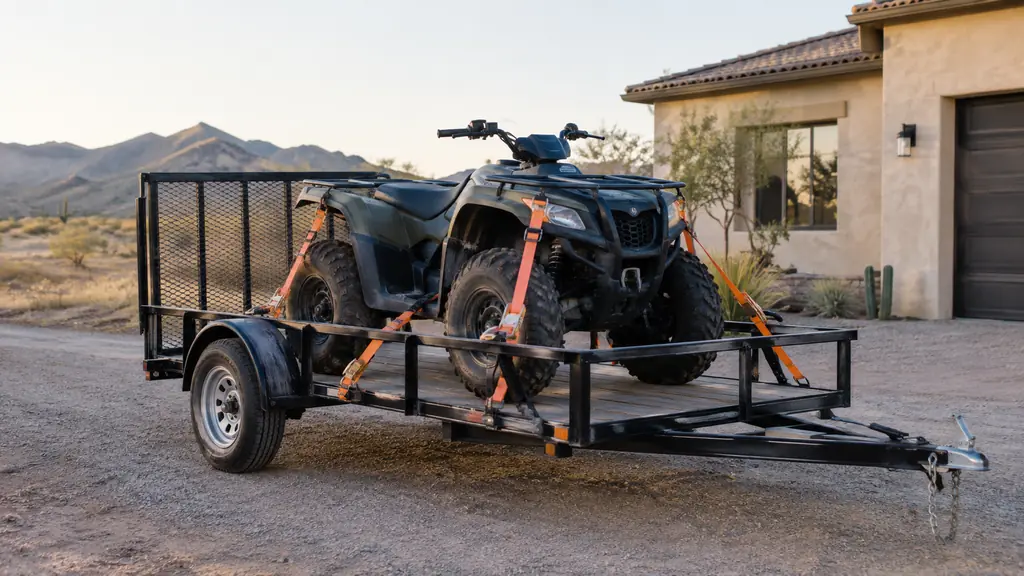
The first time I hauled my Grizzly on an open trailer, I used two ratchet straps. One across the front rack, one across the back. Seemed like plenty. About twelve miles in, on a stretch of washboard, I heard a dull knock coming from behind me. I pulled over and found the quad had shifted a full foot forward. The front strap had gone slack. The rear strap was doing all the work, and it was about to give up too. That knock is a sound I have not heard since, and I have made sure I never hear it again.
I'm Cal Mercer. I'm 58, I live outside Ridgecrest, California, on the edge of the high desert, and I've hauled quads for more years than I like to count. My machine is a 2019 Yamaha Grizzly 700 that I ride in the washes and on the fire roads most weekends. That first loose strap cost me a morning and a new respect for tie-downs. The straps I settled on after that day are FORTEM ratchet straps, and this article is the method I'd walk a friend through at the trailer.
That morning I was hauling with two friends. Both of them had done the same two-strap setup for years, and both of them told me the same thing: 'it's fine, you'll see'. It wasn't fine, and the proof was sitting a foot forward on the trailer. We spent the next twenty minutes re-strapping the right way, and I have done it the right way ever since.
Why Two Straps Isn't Enough
Here's what the two-strap method gets wrong. A quad has four corners, and each corner wants to move independently. Two straps only hold two of them. The machine can pivot on the two strapped points, and it can shift sideways on the two loose ones. The heavier the load, the more the forces multiply on rough roads, and the more likely that pivot becomes a tip.
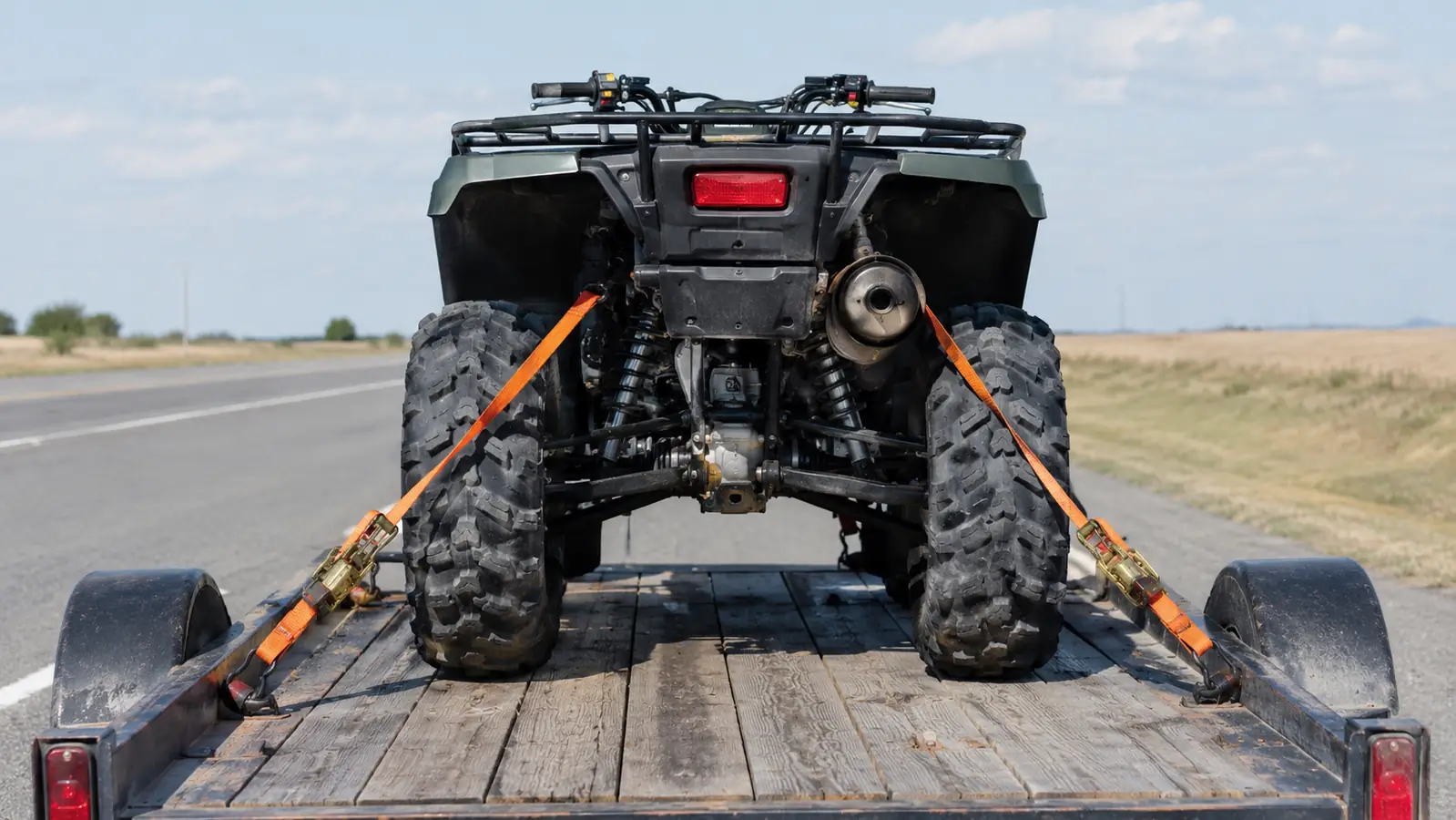
The fix is four points, one on each corner, all anchored to steel. The method I use now takes about ten minutes, and it has never once let a machine shift on me. The straps I use are FORTEM ratchet straps, a four-pack rated at 1,650 pounds of break strength each. They've been on every load since that bad morning, and they are the answer to the question this article is really about: how do you strap an ATV down so it never moves?
Before I get into the steps, one note on straps in general. Break strength is the number that matters. A strap rated at 1,650 pounds has nearly a ton of holding force behind each corner of the machine. Four of those, evenly tensioned, hold a 700-class quad like it's bolted down.
The four straps I trust on every load
FORTEM ratchet straps, 1,650 lb break strength each, have held my Grizzly square through washboard, highway, and every rough mile in between. Four points, ten minutes, zero shift.
Amazon Check Today's Price on Amazon →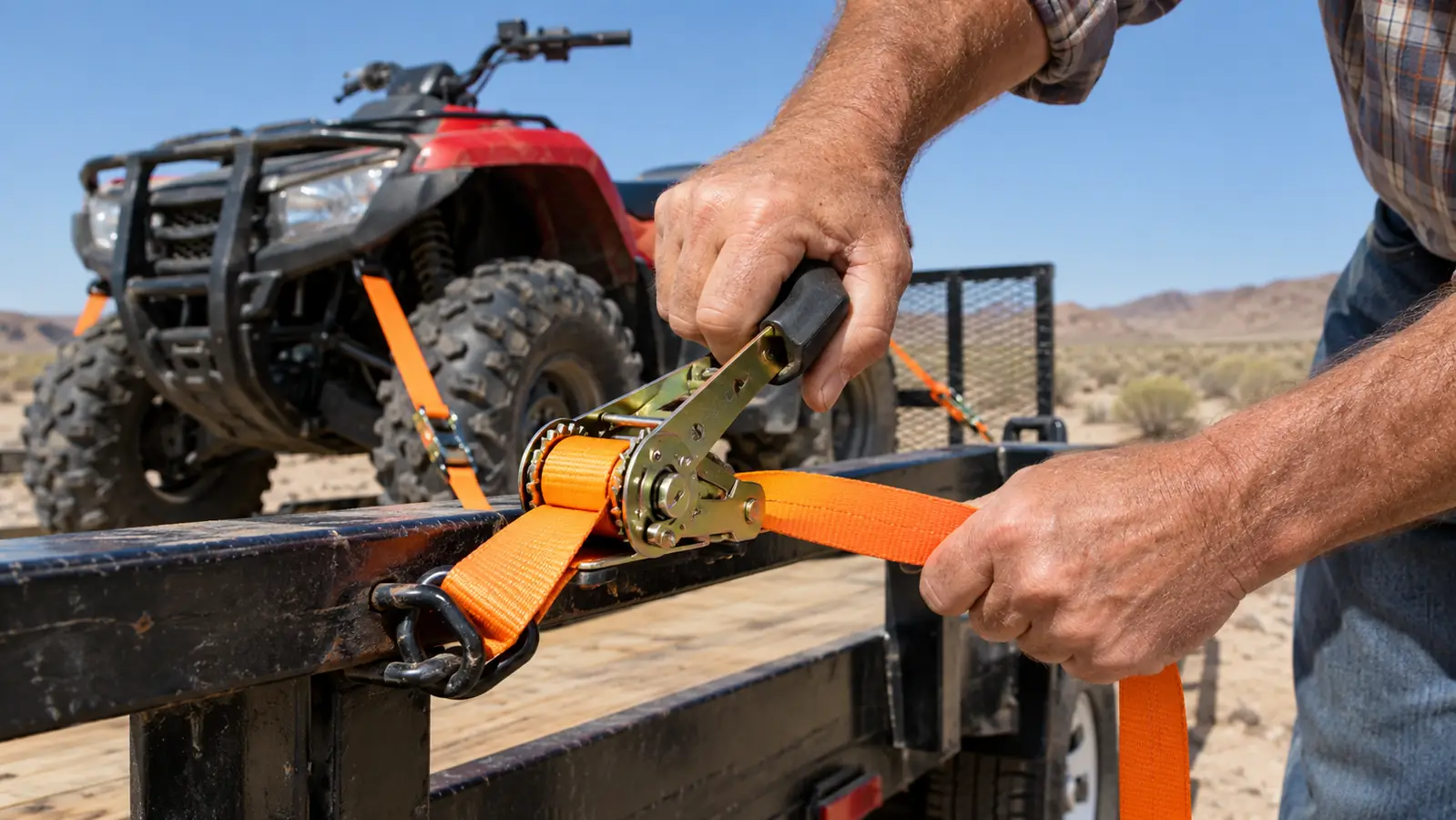
The Four-Point Method, Step by Step
The whole system comes down to five steps, and each one matters. Skip one and you're back to gambling on the road. Here's how I do it, in the order I do it.
Step 1: Pick steel anchor points, never plastic
The first mistake most people make is strapping to the first thing that looks solid. The front rack looks like a good anchor. It often isn't. Plastic body panels are never a good anchor. Neither is a bumper that flexes when you push on it. A strap is only as good as what it's hooked to, and a hook on flexing plastic is a strap that will come loose at the worst possible moment.
On my Grizzly, the points I trust are the lower A-arms up front, right where they meet the frame. Those are steel, they don't flex, and they hold the suspension in a natural position. Out back, I hook to the frame rails just behind the foot pegs. Same idea. Steel, solid, no give.
Pay attention to hook direction. A hook that sits sideways can work its way loose over a long stretch of rough road. I seat each hook so the strap pulls straight against the anchor, then I give the hook a sharp tug before I move to the next one. That two-second check has saved me more times than I can count.
Step 2: Strap the front first, then the rear
Order matters more than people think. I always do the front wheels first. The front of the quad is the heavy end, and it's the end that does the steering. Locking it down first keeps the machine from walking side to side while you work on the back.
Once the front is snug, I pull the quad forward until the rear tires settle against the front straps, then I set the rear straps. That light tension on the front is what keeps the whole machine from sliding backward during the first few miles, before the rear straps have taken their load.
If your trailer has wheel chocks, use them. Chocks hold the tires in place, and the straps hold the machine down. They do different jobs, and together they are better than either one alone. If your trailer doesn't have chocks, they are a cheap upgrade, and I'll come back to them in a minute.
One more thing about the front straps. I hook them low on the A-arms, not high on the rack. A strap hooked high has a longer lever arm, and a long lever arm means more rocking on the road. Hooked low, the strap holds the suspension at its natural height and the quad rides like it's parked.
Step 3: Work the ratchet the right way
Here's where the FORTEM straps earn their keep. The ratchet is smooth, the teeth engage cleanly, and the handle folds flat against the strap when you're done, so it doesn't rattle against the trailer rail. I've used cheap ratchets that skip and slip. A ratchet that slips while you're tightening is a strap you can't trust, and a strap you can't trust is worthless.
The technique is straightforward. Feed the strap through the slot, pull it hand tight, then ratchet in short, even strokes. You want the strap firm, not screaming tight. Over-tightening a quad on its suspension compresses the shocks and lets the machine bounce on the trailer instead of riding on them. The strap should be snug enough that you can't slide it sideways on the anchor by hand, but not so tight that you're flexing the frame.
I tighten the two front straps, then the two rear straps, then go back and take another half turn on each. That evens out the tension across all four points and keeps the quad from sitting cocked on the trailer. A quad that's cocked even a little will wear one tire and pull to one side on the road.
Step 4: Route the straps so nothing rubs
The straps themselves need a clear path. A strap that runs against a sharp edge, a hot exhaust, or a spinning tire is a strap that is going to fail, and it will pick the worst moment to do it. I route mine so they clear the tires by a wide margin, and I check that no strap touches the exhaust pipe on either side.
Watch the angle too. Straps that run straight down to the trailer hook are doing their job. A strap that angles sharply toward the middle of the trailer is putting sideways force on the anchor, and sideways force is how hooks pull loose. If the angle looks wrong, move the trailer hook or adjust the anchor point until the strap runs clean.
The FORTEM hooks are coated, which sounds like a small thing until you've watched an uncoated hook chew a groove into a trailer rail over a few seasons. The coating keeps the hooks from scratching the frame and the trailer both, and it keeps the hook from rusting where the coating would wear off.
Step 5: Do the five-mile check, every single time
The most important step is the one most people skip. Drive five miles, pull over, and check the straps. On a new load they will almost always need a small re-tighten. The straps stretch a little, the quad settles on its suspension, and the whole load finds its rhythm. That first check catches all of it.
I check again at twenty miles if I'm going any distance, and after that a quick glance at every fuel stop is enough. The FORTEM straps have held their tension better than any set I've owned, but I still check. A strap that's fine today can work loose tomorrow, and the cost of checking is thirty seconds.
One last thing I do before I leave the driveway: I give the front rack a hard shove. If the quad rocks, the straps aren't tight enough. If it sits solid, I'm good to go. That shove has caught a loose strap more than once, and it takes less time than tying my boots.
If you're hauling a long distance, say a few hundred miles, do the five-mile check, then again at twenty, then at every stop. It takes less than a minute each time, and a minute at a fuel stop is a small price for knowing the load is still square.
What Else Helps
Wheel chocks are the best addition to this system. They're cheap, they bolt or clamp to the trailer floor, and they take the tire-holding job off the straps. With chocks in place, the straps only have to hold the machine down, not hold it in position, and that makes the whole setup more forgiving.
Soft loops are worth having if your anchor points are round tubes. A soft loop wraps around the frame, and the strap hooks to the loop, so the strap isn't cutting into the steel. On my Grizzly the A-arms are flat enough that I don't always need them, but I keep a set in the trailer for when I'm hauling a friend's machine.
A spare strap lives in the trailer toolbox. If one ever fails on the road, I want a replacement that I know fits and works, not a guess at a gas station. The FORTEM set is a four-pack, which means I have spares even before I buy extras, and that's one reason I went with it.
And check the trailer itself. Tie-down points rated for the load, a coupler that's solid, brakes that work. The straps are only part of the system, and the rest of the system has to hold up its end too.
Tire pressure is worth a look before you load. A low tire on the quad or the trailer changes how the load sits, and how it sits is how it rides. I check the quad's tires when I check the trailer, and I top them off if they're low.
Keep the straps clean. Dirt and sand work into the webbing and the ratchet, and grit in a ratchet is what makes it skip. I shake mine out after a dusty trip and hang them in the garage where they can dry. Ten seconds of care keeps a good set good for years.
Two straps let my Grizzly shift a foot on the trailer. Four FORTEM straps, at 1,650 pounds each, have held it square through every mile since.
The Ten-Minute Habit
Here's what I want you to take from all this. Tying down an ATV the right way is not a skill. It's a habit. The first time takes a little longer because you're thinking about it. By the third load, it's automatic, and automatic is what you want, because automatic is what keeps you safe on a long, dusty road.
The FORTEM straps are part of that habit. Four of them, 1,650 pounds each, always in the trailer, always ready. They have never let me down, and after the morning my Grizzly shifted a foot, that is exactly the kind of reliability I look for in gear.
Haul your quad and never think about it again
The FORTEM four-pack gives you the break strength and the smooth ratchet that make the four-point method work. Load up, cinch down, check at five miles, and enjoy the ride.
Amazon Check Today's Price on Amazon →