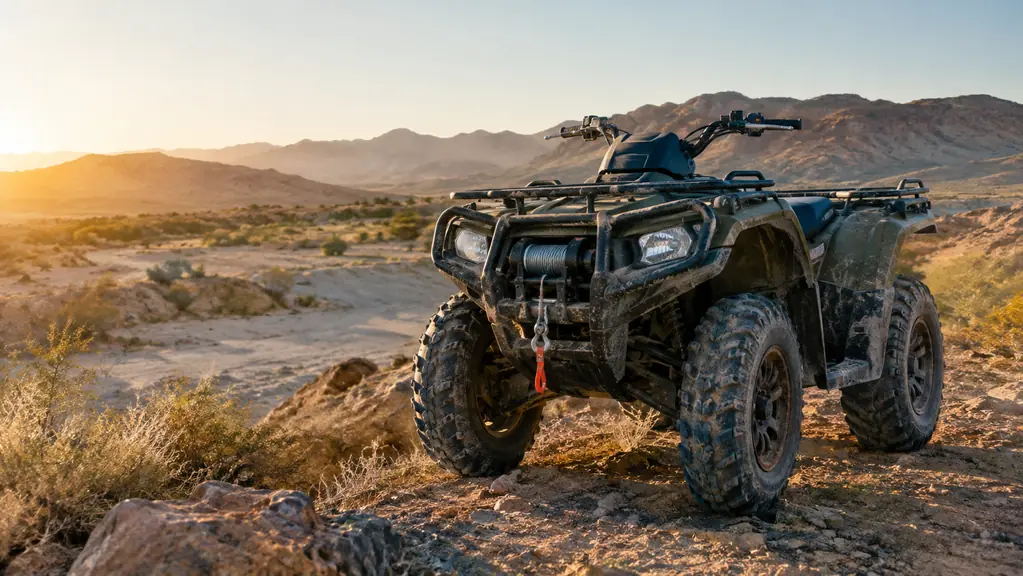
The day I needed a winch, I did not have one. It was late February, and I had the Grizzly buried to the frame in a clay wash north of Trona. The rear wheels were spinning free, and the front end was packed in mud up to the bumper. I spent the next two hours digging, stacking rocks under the tires, and cursing a machine I had owned for three years without once thinking about recovery gear. The Grizzly had been a good machine for those three years, but that day I learned that good is not the same as prepared. That night I ordered the Champion 3000-lb ATV/UTV winch kit, and by the time it arrived I had already talked myself into believing it was all I needed. A full season later, through sand, mud, and one pull that mattered more than any of them, I can tell you what that belief was worth.
Before I get into the details, here is the short version. The Champion winch has pulled my Grizzly out of every situation I have put it in, and a few I did not plan. It mounted in an afternoon with hand tools and a couple of beers. The remote has never failed me. The rope is holding up better than I expected. It is not the strongest winch you can buy, and it is not the prettiest, but for a 700-class quad used on weekend rides it has been exactly the right tool. Here is the long version.
The Quick Verdict
A dependable 3,000-lb winch that has pulled my Grizzly out of mud, sand, and a rock garden without complaint. The rope and the supplied hardware are the weak points, but the motor and the wireless remote have been flawless for a full season.
Amazon Check Today's Price →Pulled my quad out of a clay wash in one try
A full season of desert riding later, the Champion 3000-lb winch is still spooling smooth and the remote still fires on the first press. If your quad sits without a winch the way mine did, this is the kit I would bolt on tomorrow.
Amazon Check Today's Price on Amazon →How I've Used It
I mounted the winch in mid-March on a Saturday morning, with the Grizzly up on the lift and the factory service manual open on the bench because I did not want to guess at the wiring. The kit comes with a mounting plate, the winch itself, a synthetic rope with a hook, a wired remote with a long lead, a wireless remote, and a bag of hardware. The instructions are thin, maybe six pages with small diagrams, and a couple of the torque specs are printed in the wrong order. I have seen worse, but it is worth knowing before you start.
The mount went on without drama. The plate bolts to the factory receiver on the front rack, and the winch sits on the plate with four bolts. I used blue thread locker on everything, because vibration is the thing that kills gear out here. The electrical hookup is simple: battery positive and negative, an inline breaker, and a small control box. The hardest part was routing the cables so they did not chafe on the frame. I wrapped the harness in split loom and zip-tied it every six inches. Total time was about three hours, including one trip back to the house for a longer drill bit. I have never had to re-tighten the mount bolts since, which tells me the thread locker was worth the two minutes it took.
Since then, the winch has done real work. I have used it to pull the quad out of sand twice, out of mud once, and up a rock ledge on a fire road that I should not have tried in the first place. I have also used it as a come-along to drag a dead mesquite trunk off the trail, and to tension a tarp over camp gear on a two-night trip in the Panamints. It has been spooled and unspooled more times in a year than most winches see in five, and it has not complained once.
Maintenance has been almost nothing. In November I checked the rope for fraying and wiped the fairlead rollers with a rag. That is the whole list. The control box is sealed, and I have not had a single electrical hiccup even after crossings that put water over the front rack. I changed the 9-volt battery in the wireless remote once, at the start of the season, because it is cheap insurance. Ten minutes of care a year, and it keeps working.
What Comes in the Box and How It Mounts
The motor is the heart of this kit, and it is a 1.3 horsepower permanent magnet unit. That works out to 3,000 pounds of single-line pull at the drum, which is more than enough for a 700-class machine. The gear train is a three-stage planetary setup, the same design used on winches that cost twice as much. The housing is sealed, and after a season of dust, heat, and water crossings I have not seen any oil weeping out of the case.
The rope is synthetic, and I will be honest, I was skeptical at first. I grew up with steel cable on tractor winches, and synthetic felt like a downgrade. After a season I have changed my mind. The rope is lighter, easier to handle, and it does not throw burrs into your gloves the way steel does. The tradeoff is that it wears where it rubs against rock, so I carry a short length of rubber hose and slip it over the rope wherever it crosses an edge. That is a five-minute habit, and it has saved the rope at least twice.
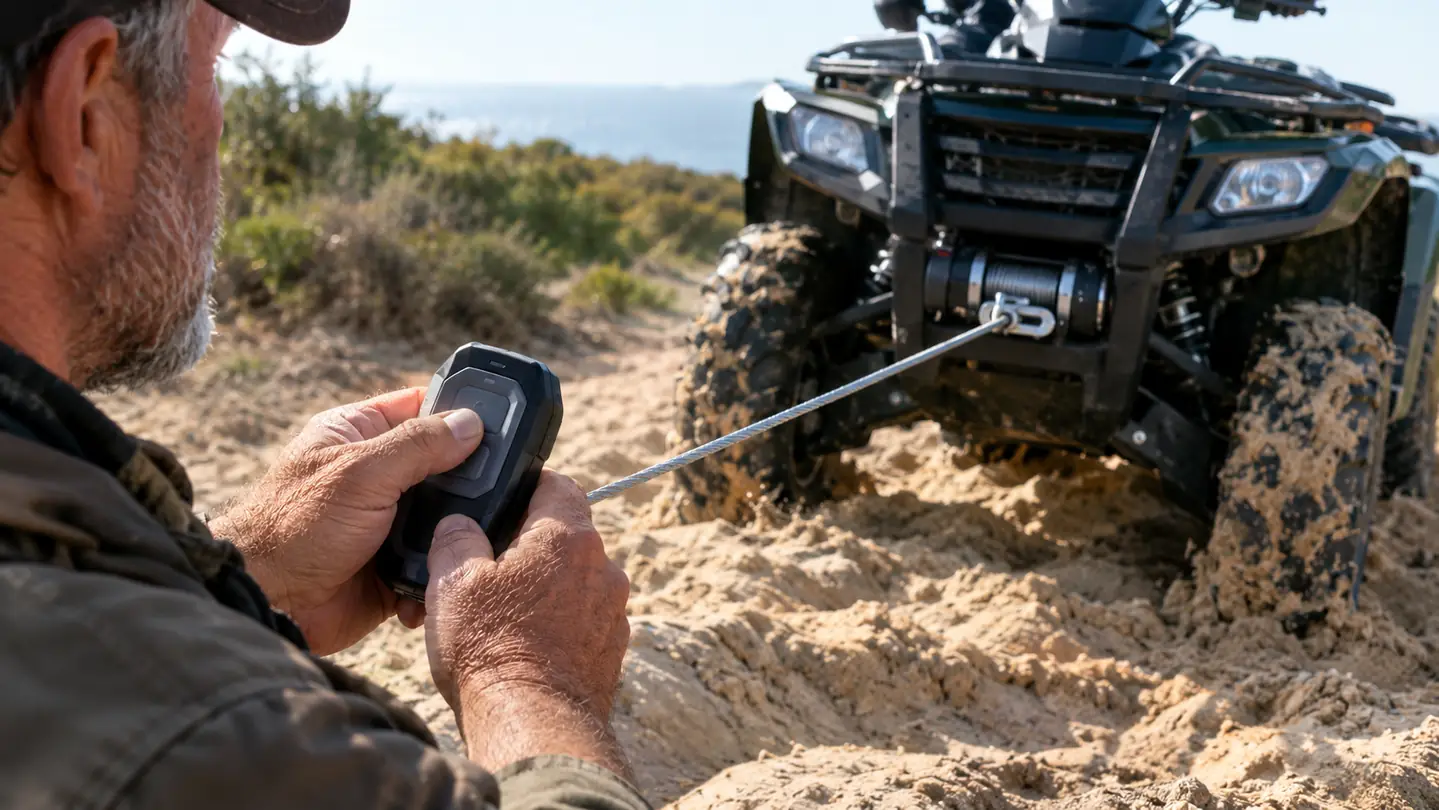
The fairlead is a roller type, and the rollers spin freely even after being packed with mud. The hook is a standard clevis hook with a safety latch, and the latch has not bent or jammed. The wireless remote is the feature I use the most. It works from about thirty feet away, which matters when you are standing on a bank above the quad instead of standing in the mud next to it. The remote lives in a zippered pouch on the front rack when I am riding, and it has survived a season of dust and one good dunking. It takes one 9-volt battery, and I am still on the first one after a year.
Performance: Mud, Sand, and the One Pull That Mattered
The first real test was a sand pull in late April. The guys I ride with and I were in a wash south of Ridgecrest, and I drove the Grizzly into a soft patch that had fooled me the year before. The tires dug down to the axles in about ten seconds. I pulled out the remote, hooked the rope to a mesquite root that turned out to be deeper than it looked, and let the winch do the work. The quad came out smooth and steady, no jerking, no strain. That was the moment I stopped worrying about whether the winch was strong enough.
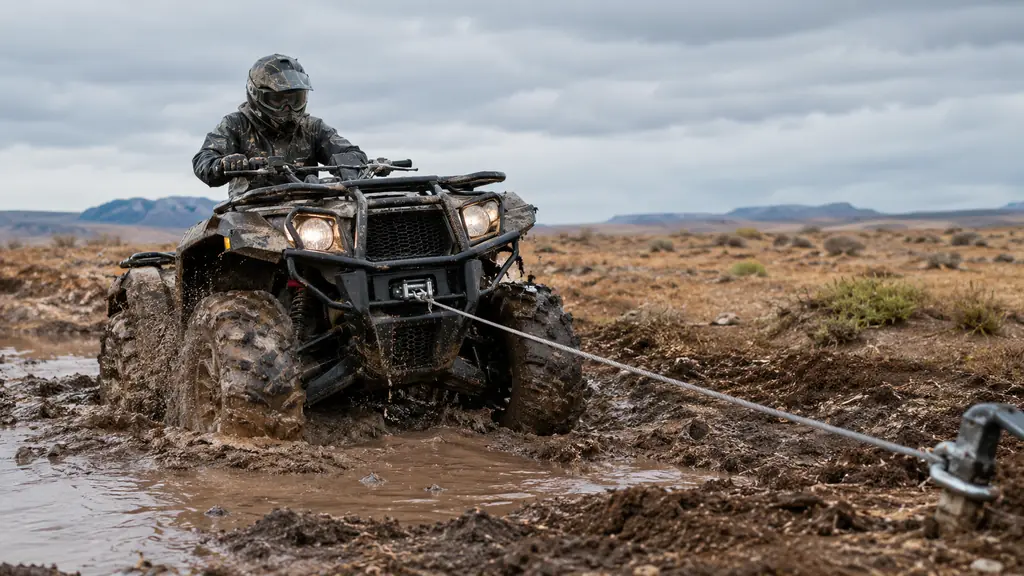
The mud test came in June, after a thunderstorm turned a normally dry crossing into a bog. The Grizzly sank to the floorboards in about twenty feet, and the winch had to pull it out of thick clay that was grabbing the skid plate. That pull took the winch maybe four minutes of steady work, and the motor stayed cool enough to touch when it was done. I did not have to wait for it to cool before the next pull, which is more than I can say for a friend's winch on the same trip.
The pull that mattered was in September, in a rock garden on a trail that dead-ended. A buddy of mine had high-centered his quad on a boulder, with the front wheels off the ground. We tried pushing, we tried rocks under the tires, and then we hooked the Champion to his front frame and used it to pull him backward off the rock. The rope went taut, the winch took the strain, and the quad came free in one steady pull. It did not hesitate, it did not stall, and the motor did not even feel warm afterward. The guys I ride with still talk about that pull. That is when I stopped thinking of the winch as a piece of gear and started thinking of it as part of the machine.
In November I used it one more time, on a cold morning when the temperature was barely above freezing and the ground was hard. I had winched a dead juniper stump out of the way so the truck could turn around on a narrow track. The winch pulled it free without drama, the rope working fine in the cold. It has been reliable in every temperature I have thrown at it, which out here means everything from 110 in July to the low 20s in January.
The Remote, the Rope, and the Little Things That Annoy Me
The weak points are the ones you would guess. The rope is the first thing that will wear, and you should expect to replace it eventually if you ride where there is rock. The supplied hardware is adequate but not premium; the bolts are fine, but I swapped them for grade 8 fasteners because I have them in the shop and it is cheap insurance. The winch is loud, which is normal for a planetary gear unit, but it is worth knowing if you are used to the whine of a hydraulic winch on a truck.
The wired remote that comes in the box is a fallback, and I have used it once, when I wanted to run the winch from the tailgate of the truck while loading firewood. The lead is long enough, and the toggle switch works. I have never needed it in the field, because the wireless remote has never let me down. The one thing I would change is the hook. The safety latch is fine, but I would rather the kit came with a snatch block for doubling the line when you need extra pull. That is a small complaint, and I carry a snatch block in my bag now anyway.
Alternatives I Considered Before I Bought
Before I bought the Champion, I looked hard at a Superwinch and a Warn. The Warn is a great winch, no argument, but it costs more than twice as much, and I could not justify that for a quad that sees weekend duty. The Superwinch is a solid competitor at a similar price, and I came close to ordering one. What pushed me to the Champion was the wireless remote in the box and the fact that I have owned a Champion generator for eight years and it has never let me down. That counted for a lot. I do not regret passing on either of the other two, but I did not make the call lightly.
I also thought about a 4,500-pound winch, because more capacity sounds like a good idea until you carry it. The 3,000-pound unit is lighter, smaller, and draws less current, which matters on a stock quad battery. For a 700-class machine, 3,000 pounds is the right number. A heavier winch adds weight up front that you feel in the steering, and it is more than most riders will ever need. I made the right call, and I would make it again.
What I Liked
- Wireless remote works from thirty feet and has never failed
- Smooth, steady pulls on a 700-class quad
- Mounted in an afternoon with hand tools
- Synthetic rope is light and easy to handle
- Motor stays cool even on long pulls
Where It Falls Short
- Synthetic rope wears against rock and needs checking
- Instructions are thin and a couple of torque specs are misordered
- Supplied hardware is adequate but not premium
- Planetary gears are loud, which is normal but noticeable
The rope went taut, the winch took the strain, and the quad came free in one steady pull. It did not hesitate, it did not stall.
Who This Is For
This winch is for the weekend rider who owns one quad, rides it in sand, mud, and on fire roads, and wants the peace of mind of knowing the machine can always get itself out. If you ride alone, which I do plenty, a winch is not a luxury. It is the difference between a twenty-minute recovery and a four-hour walk back to the truck in the heat. It is also for the rider who would rather spend an afternoon bolting something on than an evening walking out of the desert. If you have been stuck before and swore you would never be stuck like that again, this is the kit for you.
Who Should Skip It
Skip this winch if you ride a side by side or anything heavier than about 900 pounds, because you need more than 3,000 pounds of pull and you should step up to a larger unit. There is no shame in a bigger winch; it just is not this one. Skip it if your riding is mostly in rocky terrain where the rope will drag across sharp edges constantly, unless you are willing to carry a sleeve and check the rope before every ride. And skip it if you expect a premium kit with perfect instructions and heavy-duty hardware. The Champion is a good value, not a luxury product, and it does not pretend to be one.
A full season of pulls and it still spools like new
The Champion 3000-lb winch has earned its spot on my Grizzly. If your quad is still riding without one, this is the kit I would bolt on before the next trip into the desert.
Amazon Check Today's Price on Amazon →