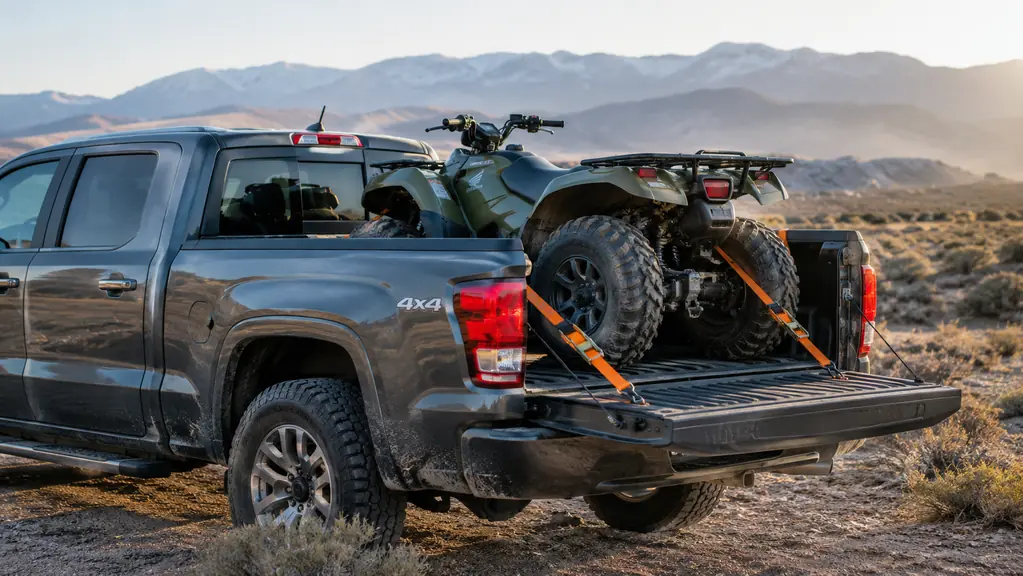
The first time I hauled my Grizzly 700 to the desert, I used a pair of cam buckle straps that had been riding in the bed of my truck for three seasons. They got the quad there, but it had shifted a full inch off center by the time I hit the graded road, and one hook had worn a bright groove in the powder coat on the frame. That trip taught me the difference between holding a load and holding it right. Since then I have hauled with both soft loop tie-downs and a set of FORTEM ratchet straps, on the same trailer and the same route, and I can tell you exactly where each one earns its place.
The short answer: if you haul an ATV more than a few miles, or on anything rougher than a smooth highway, ratchet straps win. They hold full tension, they do not creep, and they are the difference between a load that arrives exactly where you left it and one that has shifted. Soft loop tie-downs win when you care most about the paint and the suspension, when your hauls are short, and when you want something that is almost impossible to over-tighten. I keep both sets in the shop. If I could only keep one set for the Grizzly, it would be the FORTEM ratchet straps. There is no single right answer for everyone, and the honest thing to do is match the strap to the trip.
How I've Hauled With Both
My test setup is nothing fancy. I load the Grizzly into my trailer, cinch it down with one type of tie-down, and drive the 40 minutes of highway and 15 minutes of washboard fire road to my usual riding spot. I do the same trip with the other type a week later. I check the straps at every stop, I watch how much the quad moves in the mirrors, and I look at the frame when I unload. I have done this a dozen times over two seasons, both with a bare frame and with a folded towel under the hooks. My trailer is a simple two rail setup, so the straps anchor at the four corners, two front and two back, crossing slightly to keep the quad from walking side to side.
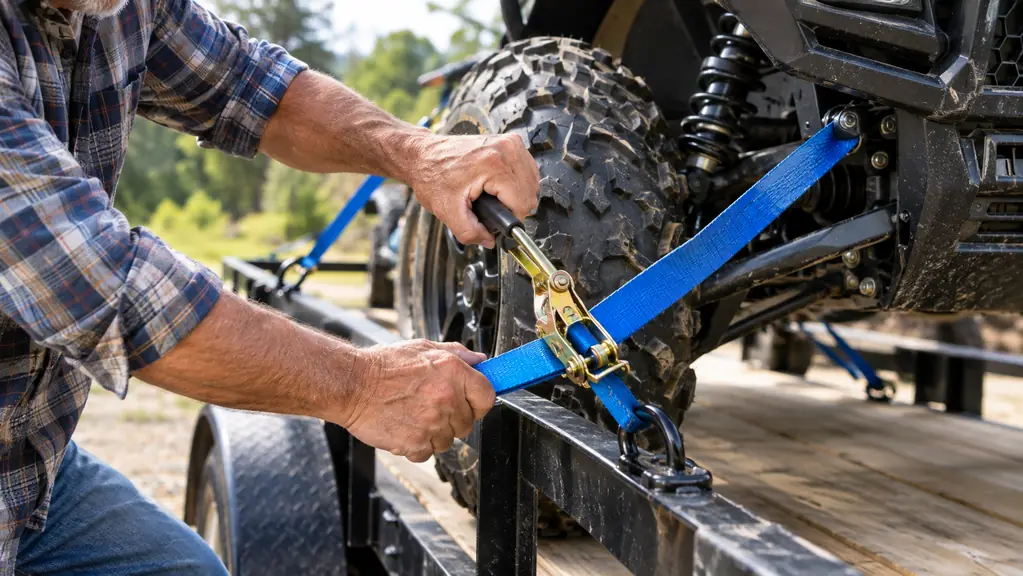
The FORTEM set is four ratchet straps rated at 1,650 lb break strength each, which is more than enough for a 700 lb machine with plenty of margin. What matters is the ratchet mechanism. It lets you add tension a click at a time until the strap is genuinely tight, and it holds that tension because the pawl locks mechanically. The soft loop tie-downs I compared them against use a cam buckle. You pull the strap through and the cam holds it. It is faster to set up and gentler on the machine, but it tops out at a lower tension and it relies on friction in the cam to hold. Both sets have the same basic job: keep a 700 lb machine from moving while the trailer moves underneath it. How they do that job is where they part ways.
The Test That Settled It
On the highway, both types held the quad in place. The difference showed up on the fire road. The washboard shook the trailer hard enough that I could feel it through the truck, and that is where the cam buckle straps started to give. By the end of the graded section, the Grizzly had moved a solid inch on the trailer deck, and one strap had enough slack that I could pinch the webbing between two fingers. The FORTEM ratchet straps, tightened the same way, did not move at all. The quad sat exactly where I had set it when I pulled into camp. I checked all four corners before unloading, and every strap was still tight enough that I could not move the webbing by hand.
The other thing I noticed was release. A ratchet strap under full tension needs a firm pull on the release lever, and even then the strap can spring free hard enough to sting your knuckles if you are not holding it. The cam buckle just flips open and the strap slides out. That is a small thing at the end of a long day, but it is worth knowing before you buy. It is also worth knowing that a ratchet strap has a learning curve. The first time you use one, you will probably overtighten it, or you will pull the release lever and let the strap snap back at you. Give yourself one practice session in the driveway before your first real haul.
| FORTEM Ratchet Straps | Soft Loop Tie-Downs | |
|---|---|---|
| Holding power | Ratchets cinch to full tension, 1,650 lb break strength per strap | Cam buckle tops out at modest tension |
| Stays tight on a long haul | Locking pawl holds tension, no creep on washboard roads | Cam can loosen on rough roads, needs a check at stops |
| Paint and frame protection | Metal hooks need pads or soft loops to avoid scratching | Soft woven loops wrap the frame with no metal contact |
| Ease of release | Release lever works, but strap is under full tension | Cam flips open, strap slides out easily |
| Risk of over-tightening | Easy to compress the suspension if you reef on the handle | Harder to over-tighten, more forgiving |
| Best for | Long hauls, heavy ATVs, rough roads | Short trips, paint-conscious owners |
Where FORTEM Ratchet Straps Win
Holding power is the whole argument for ratchet straps, and it is not close. A ratchet lets you add tension in small, controlled increments until the strap is genuinely tight. I can feel the difference in the trailer: with the FORTEM set cinched down, the Grizzly does not budge when I push on the handlebars. With a cam buckle strap, I can always get a little movement out of the machine, because the cam simply cannot put that much tension on the strap. On the washboard road, that difference shows up as a quad that stays put versus one that shifts a half inch with every bump. If you are hauling a heavy machine, that extra holding power is not a luxury. It is the whole point.
The second win is that the ratchet holds its tension. Cam buckles rely on friction in the cam, and vibration works against them over time. I have had a cam buckle loosen noticeably over a 40 minute highway run. The ratchet pawl on the FORTEM straps locks mechanically, so once the strap is tight, it stays tight until you release it. For anyone hauling a 700 lb machine on rough roads, that is the difference between confidence and a knot in your stomach every time you check the mirror. The FORTEM straps have never once loosened on me.
Where Soft Loop Tie-Downs Win
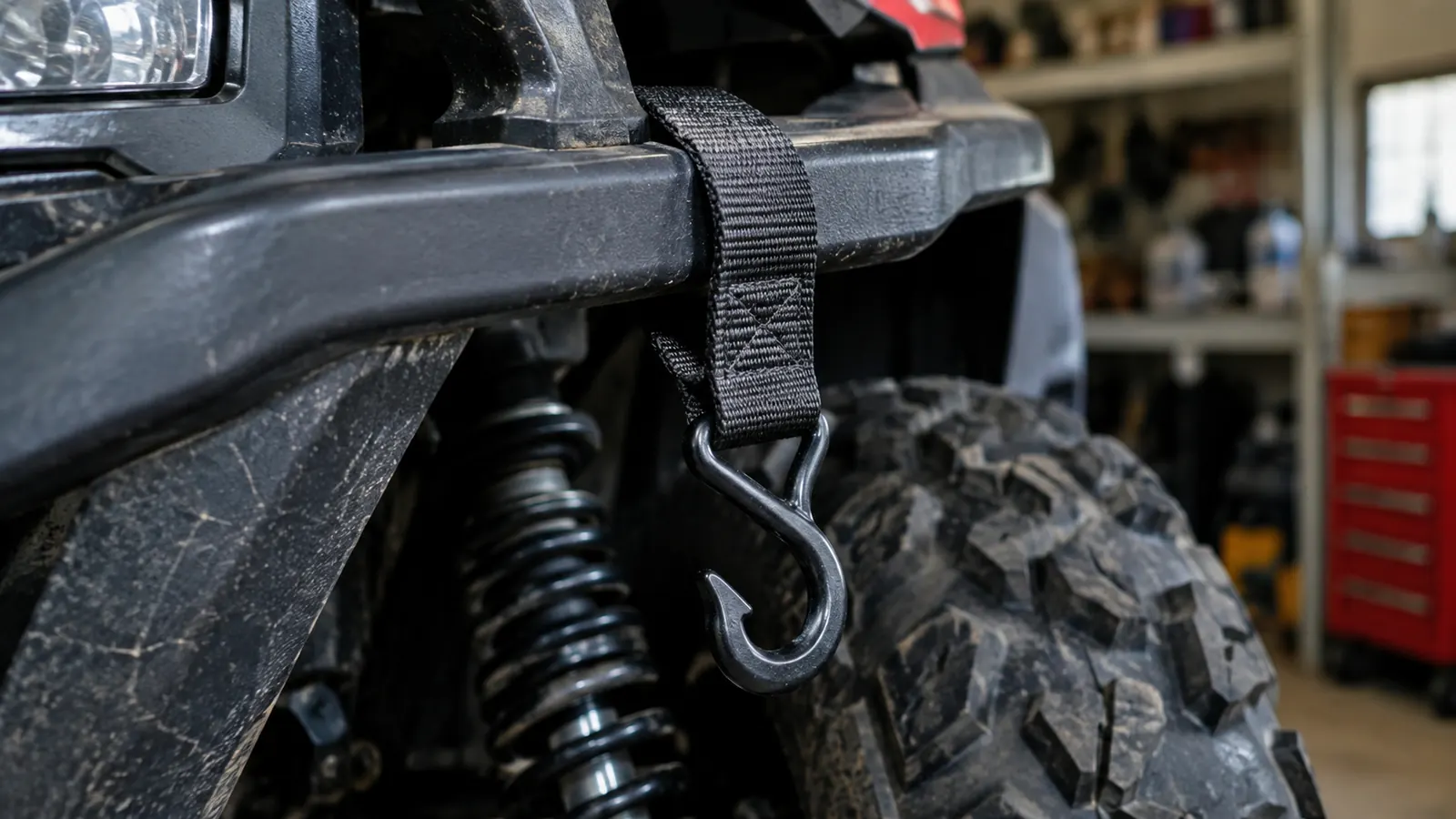
Paint protection is the soft loop's whole job, and it does it better than any metal hook. The soft loop is a woven sleeve that wraps around the frame, so no metal touches the powder coat. When I use the FORTEM straps with their metal hooks, I fold a towel under each hook or add a soft loop protector, because I have already seen what a bare hook does over a long haul. The soft loop tie-down eliminates that worry entirely. If you are hauling a quad you just bought, or one with a finish you care about, that is worth a lot. It is also worth something if you haul a machine that sees a lot of vibration, because a metal hook rubbing against a frame for 40 miles can wear through the finish faster than you would expect.
The second win is forgiveness. It is very hard to over-tighten a cam buckle to the point of compressing the suspension, because the cam gives out before the strap reaches that much tension. With a ratchet, you can keep cranking until the springs are fully compressed and the machine is sitting on its bump stops. I have seen riders do exactly that, usually after watching someone else's straps come loose. Over-tightening is hard on bushings and can leave the quad handling wrong when you unload it. The soft loop tie-down is much more forgiving for a less experienced hand, and it is quicker to set up when you are in a hurry.
The ratchet straps that hold a 700 lb quad dead center on rough roads
FORTEM's 4 pack of 1,650 lb ratchet straps has held my Grizzly exactly where I set it through two seasons of washboard roads. Full tension, no creep, and a release lever that works even under load. Add a set of soft loop protectors if you care about the paint.
Amazon Check Today's Price on Amazon →How to Avoid the Two Mistakes I Made
The first mistake is over-tightening. When I first started using ratchet straps, I cranked them down until the Grizzly's suspension was fully compressed. The machine sat low and looked secure, but it was riding on its bump stops, which is hard on the bushings and makes the quad handle wrong when you unload it. The right way is to tighten until the strap is firm and the machine does not move when you push on it, then stop. You want the suspension to absorb road vibration, not to be locked solid.
The second mistake is letting a metal hook sit directly on the frame. A bare hook will rub through powder coat on a long haul, and I have the groove in my Grizzly's frame to prove it. A folded towel, a piece of rubber mat, or a soft loop protector under each hook solves the problem completely. If you are buying the FORTEM straps, pick up a set of soft loop protectors at the same time and you will never have to think about it again.
The third thing I would tell anyone is to check your straps at the first stop, whatever kind you use. A loose strap is a load that can move, and a load that moves on a trailer can end badly. Thirty seconds with your hand on each strap at the first gas station is cheap insurance. I have never had a strap come all the way loose on a haul, but I have found a cam buckle that had worked itself noticeably looser after a rough stretch, and I would rather know that at a stop than at the end of the road.
Who Should Buy Which
Buy the FORTEM ratchet straps if you haul your ATV more than a few miles, if your route includes dirt roads or anything that shakes, or if you have ever looked in the mirror and watched your load shift. That covers most riders I know. The ratchet is the standard for a reason: it holds, it stays tight, and it releases cleanly. It is also the safer choice if you are hauling a heavy machine, because the extra tension keeps the quad from walking on the deck.
Buy soft loop tie-downs if you only trailer the quad across town, if the machine lives on a trailer that barely moves, or if you are hauling a machine with a finish you cannot stand to scratch. They are gentler and more forgiving, and for short, smooth hauls they are plenty. Just check the straps at every stop, because a cam buckle can loosen on a rough road, and a loose strap is a load that can move.
My honest recommendation is to get the FORTEM ratchet straps as your main set and keep a pair of soft loop tie-downs as a backup for quick local trips. That covers every situation I have run into in ten years of hauling quads. It means you never have to choose between holding power and paint protection. You just pick the right tool for the trip, and you know from experience that both of them will do the job they were made for.
Haul with full tension and zero creep
FORTEM's 4 pack of 1,650 lb ratchet straps has carried my Grizzly through two seasons of desert trips. Mechanically locking ratchets, clean release, and enough strength for a machine twice the size of mine. If you haul quads, this is the set to start with.
Amazon Check Today's Price on Amazon →