
I bought this FORTEM four pack in March of last year, and in the twelve months since I have used it on something like thirty hauls. Most were the run from my place outside Ridgecrest out to the washes below the Slate Range, an hour each way on a mix of highway and washboard dirt. A few were longer. Two were the kind of trip where the loaded trailer sat in a dirt lot overnight in wind that never quit. That is the use I wanted to report on, because any tie down looks fine after one weekend and tells you nothing. A year is long enough for webbing to fade, for a ratchet to pack full of grit, and for weak stitching to start walking apart. I have opinions now that I did not have in week one, and most of them are good ones.
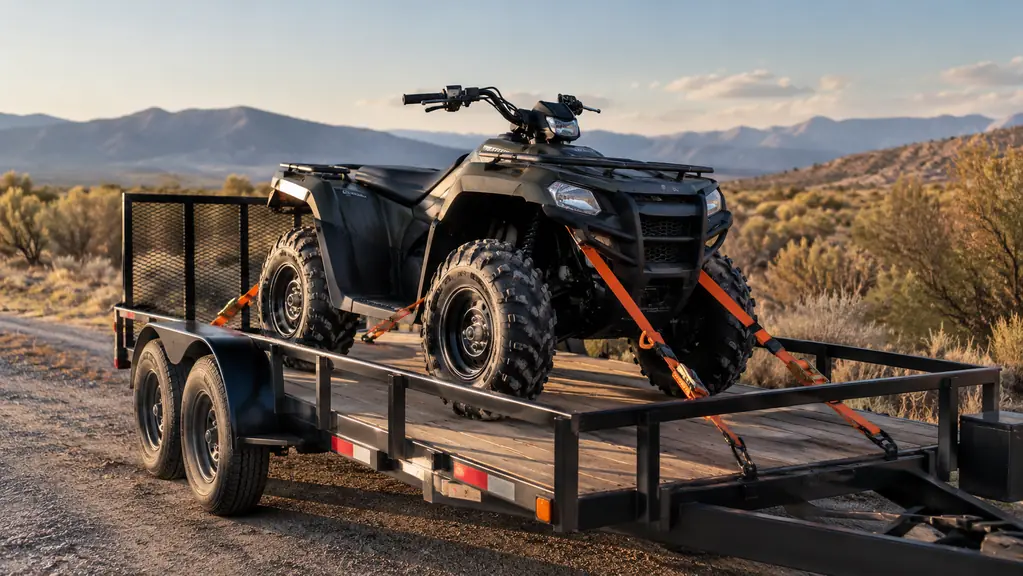
The machine going on the trailer is a 2019 Yamaha Grizzly 700, which is not a light quad. Loaded with a full tank and whatever is bolted to the racks it is a real weight to control, and the whole job of a strap set is to stop that weight from discovering it can move. I use four straps every time, run front and rear in a cross, and I have never been tempted to get away with two. That means the FORTEM set gets used as a complete set on every trip rather than one strap doing all the work, which is worth knowing when you read what the wear looks like below.
The Quick Verdict
Twelve months, thirty hauls and two nights parked out in wind, and all four straps are still in service with no edge fraying and no stitching pulled. The ratchets pack with grit and want a flush once a year. Not the last straps you will ever buy, but far more strap than the price suggests.
Amazon Check Today's Price →How I Actually Use Them
My routine has not changed all year. The quad goes up the ramps in low range, parked slightly nose left so the front tires sit into the corner of the deck. Then a strap from each front A arm out to the front corner D rings, crossed, so each one pulls down and away from the other. Two more from the rear grab bar to the back corners, same idea. I compress the front suspension maybe a third of the way, which is the part most people skip. A strap on an uncompressed spring goes slack the first time the trailer takes a dip, and a slack strap is how a quad starts moving. The webbing on these has enough grip in the ratchet drum that I can get that compression without fighting it.
The S hooks have a spring latch on them, and I want to be specific about why that matters more than it sounds. On the old straps I ran before this set, the bare hooks would occasionally jump a D ring while I was working the opposite corner, and I would turn around to find one lying on the deck. The latch stops that. It is a small piece of stamped metal and it is the single feature I would not give up. Over a year I have had exactly one latch spring get weak, on the strap I use most, and it still closes. It just does not snap the way the other three do.
Thirty hauls in a year, and all four straps are still in the rotation.
If you are hauling a quad on an open trailer and you are still running two straps or bare hooks, this is the set I would replace them with. Four straps, latching hooks, and enough webbing to cross front and rear properly.
Amazon Check Today's Price on Amazon →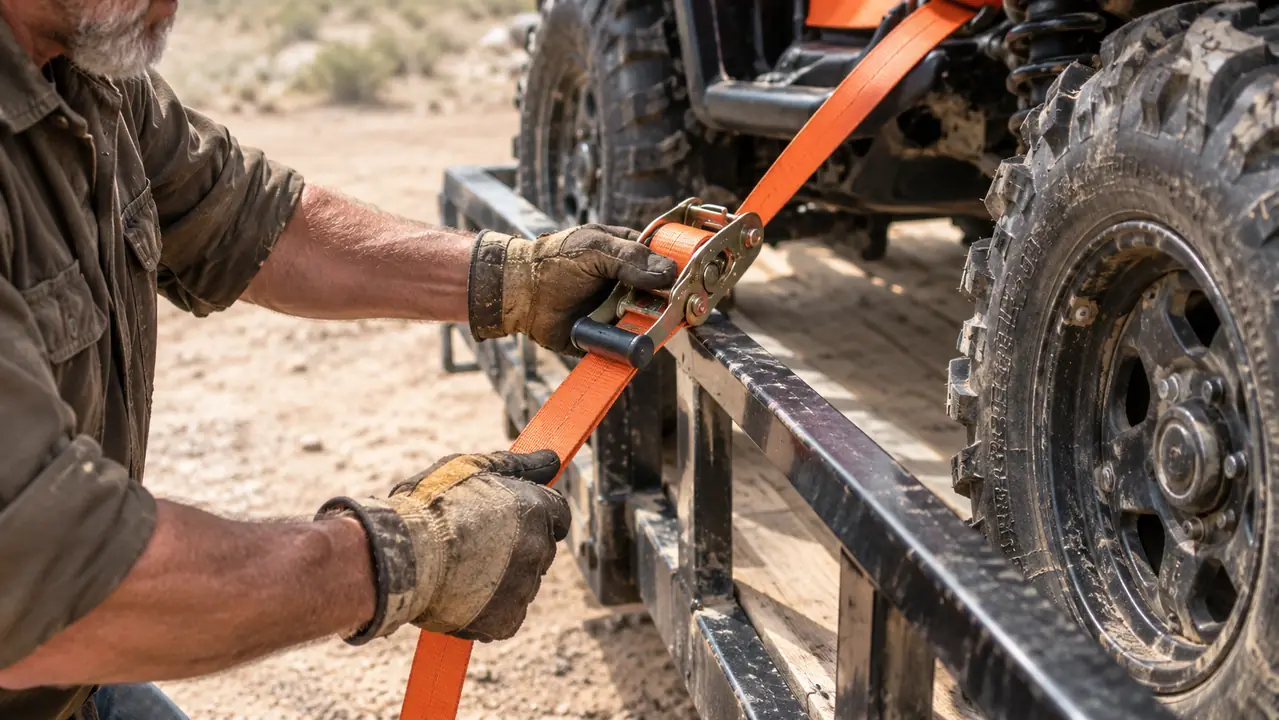
What a Year Did to the Webbing
The honest answer is less than I expected. The webbing has faded, noticeably, from the original color to something a shade or two lighter on the surfaces that face up in the sun. That is cosmetic and it happened in the first four months. What has not happened is the thing that actually matters, which is fuzzing along the edges. High desert sun kills synthetic webbing, and the failure mode is that the edge fibers go soft and fluffy and then the whole band starts losing width. I checked all four with a straightedge in February against a length I had never put under load, and I could not find a measurable difference in width on any of them.
There is wear where you would expect it. Every strap has a polished band about four inches long where it passes over the trailer rail, and on two of them that band has gone slightly glassy. That is abrasion, and it is my fault more than the strap's, because a rail edge is sharp and I should be sleeving it. I have since started putting a short piece of old garden hose split lengthwise over the rail on the two corners that do it worst. If you are buying these, do that on day one instead of month ten.
I checked all four against an unloaded length in February and could not find a measurable difference in width. After a year outdoors, that is the whole review.
Two Nights Parked Out in the Wind
The hardest thing I have asked of these was not a highway run. It was two separate nights last spring where the loaded trailer sat in an open dirt lot while the wind came through the pass and did not stop until morning. Wind is a worse test than driving, because driving puts steady load into a strap and wind puts thousands of small cycles into it. A strap that is slightly loose will saw itself against a rail all night, and you come out in the morning to find the quad has walked an inch and one strap is doing nothing.
Both times I came out to four straps at the tension I left them at. That surprised me more than anything else in the year. I had gone out at first light expecting to re tension everything and there was nothing to do. What I did find both mornings was a fine grey dust packed into the ratchet housings, thick enough to see, and that is almost certainly where the notchy release feel came from a few months later.
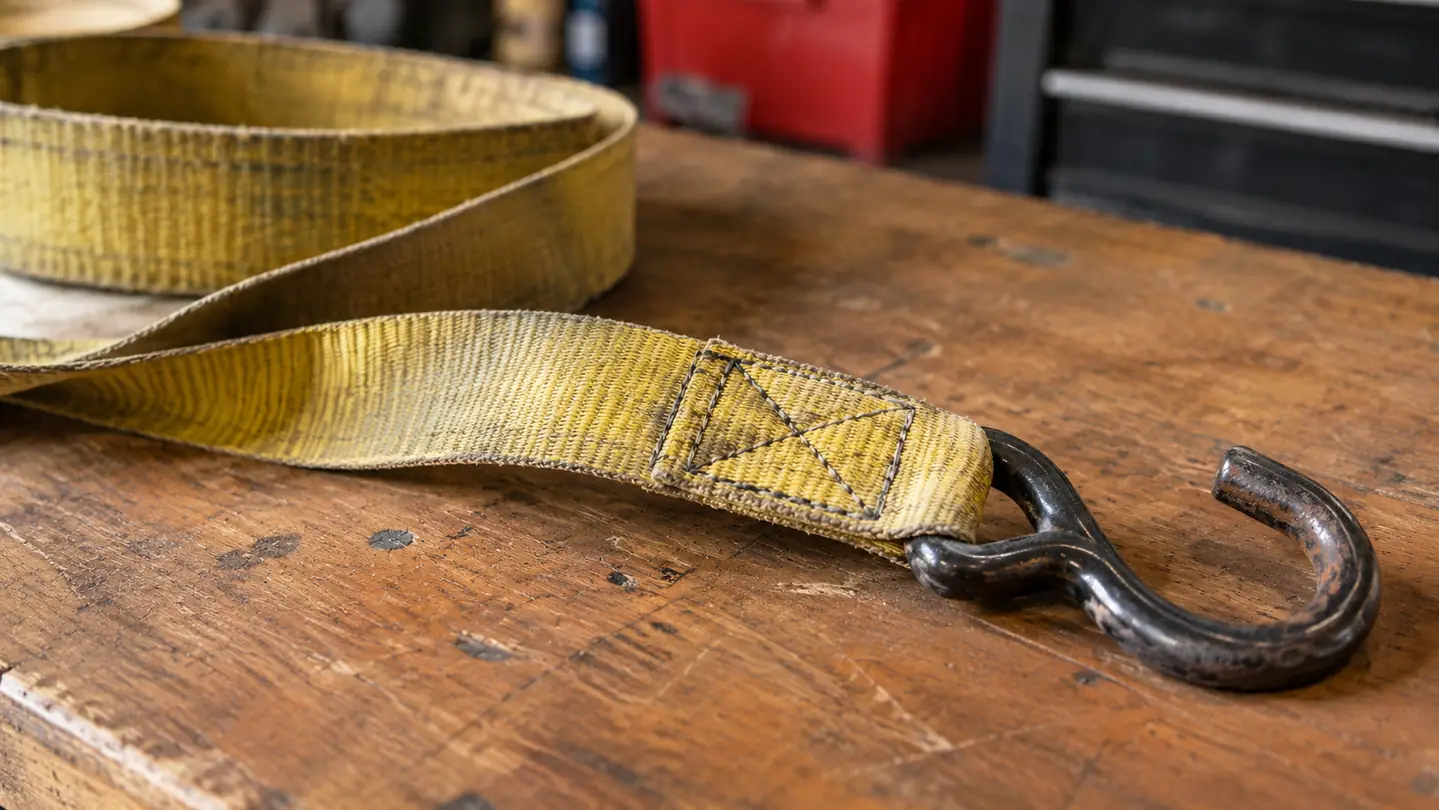
The stitching is the part I inspect most carefully, because that is where a strap actually fails. The hook ends are box stitched with a cross through the middle, and on all four the thread is intact with no loose tails and nothing pulled. I ran a thumbnail hard along each stitch line looking for a raised loop, which is the early tell, and found nothing. For a strap set at this end of the market I genuinely did not expect that. I have had more expensive straps come apart at the stitch inside two seasons.
The Ratchet Mechanism, and the Grit Problem
This is where I have the most to say and where the FORTEM set is merely fine rather than impressive. The ratchets are a conventional design, and after a year of desert use they have all picked up grit. Two of them developed a gritty, notchy feel in the release lever somewhere around month seven. It never stopped them working. It just meant the lever needed a firmer push than it did when new, and the handle no longer fell open on its own weight.
The fix took me ten minutes at the bench. I flushed all four with brake cleaner, blew them out with shop air, and put a single drop of light oil on each pawl pivot and nothing anywhere else. Oil on the drum or the teeth is a mistake because it turns the next load of dust into grinding paste. After that flush they were as smooth as new, and four months on they still are. That is the maintenance these want, once or twice a year if you ride in dust, and nobody tells you that when you buy them.
The other thing about the ratchets is the release. A ratchet under real tension needs a deliberate two stage pull to let go, and these are no different. What I will say is that the handle is wide enough to work with a glove on, which is not true of every set I have owned. In February I was unloading in the dark with cold hands and I never once had to pull a glove to release a strap. Small thing. It is the kind of small thing you notice at the end of a long day.
What I Do Not Like
Two things, and one of them is a real limitation. The first is strap length. There is a lot of tail on these, and with a quad that sits fairly high on the deck I finish every corner with a long loose end flapping. I roll and tuck them now, or knot them short, but out of the bag on day one I had four ends whipping against the trailer at highway speed. That is how webbing gets chewed, and it is worth fixing before your first trip rather than after.
The second is that the hooks are open S hooks with a latch, not a proper carabiner or a bolt through. On a D ring that is fine. On some trailer rails, where you are hooking around a square section rather than into a ring, the hook can sit at an angle it was not drawn for and load one side of the metal. I fabricated two small D ring tabs for my own deck and welded them on rather than keep hooking the rail, which solved it for good. If you do not have a welder, buy a trailer with proper rings and do not ask the hook to do something it was not shaped for.
What I Liked
- Webbing held its full width after a year of high desert sun with no edge fraying
- Box stitching at the hook ends is intact on all four after thirty hauls
- Latching S hooks stop the hook jumping the D ring while you work the opposite corner
- All four straps behave identically, so tension is predictable corner to corner
- Ratchet handle is wide enough to work with winter gloves on
Where It Falls Short
- Ratchets pack with grit and need a solvent flush about once a year in dusty country
- A lot of loose tail on each strap that needs rolling or knotting before highway speed
- Open S hooks want a proper D ring, and load badly if you hook them around a square rail
- Webbing fades noticeably in the first few months, though it stays strong
How They Compare to What I Ran Before
Before this I used a mixed bag of whatever had accumulated in the garage over the years, which I suspect is what most people are actually running. Two decent straps, one older one with a bent handle, and a cam buckle strap that had no business being anywhere near a quad. The single biggest improvement in going to a matched FORTEM set was not any individual feature. It was that all four behave identically. Same length, same ratchet feel, same tension for the same number of clicks. I can set the rear pair, walk around, and know the front pair will land in the same place without thinking about it.
That consistency is the argument for buying a four pack over accumulating singles. Tie down failures are usually not one strap snapping. They are one strap being slacker than the others, letting the load shift a little, which then unloads a second strap, and it cascades from there. A matched set makes the whole system predictable, and a predictable system is one where you notice immediately when something is wrong.
What I Check Before Every Haul
Thirty seconds, four straps, and it is always the same three things. First the stitching at the hook end, looked at directly rather than felt through a glove, because a pulled loop is visible long before it is obvious by touch. Second the edges of the webbing along the section that runs over the rail, feeling for the soft fuzzy texture that means the fibers are going. Third the latch on each hook, opened and let go, to hear it snap rather than sag.
Anything that fails one of those three comes off the trailer and gets cut in half before it goes in the bin, so it cannot find its way back into service. That last part sounds dramatic and it is genuinely the most useful habit I have. A retired strap that stays whole in a garage will absolutely end up back on a trailer two years later when you are in a hurry and short one.
Who Should Buy These
If you haul a quad, a mower, a generator, or anything in that weight class on an open trailer a few times a month, these are more strap than you probably expect for what they are and I would buy them again today. A year of high desert sun, washboard dirt roads, and two nights sitting out in wind has not put a single one of them out of service.
If you are hauling something genuinely heavy, a full size side by side or a car, this is not your strap set and you should be shopping chains and binders instead. And if you never inspect your gear, no strap will save you, because the failure that gets people is almost always a strap that was already visibly damaged before the trip started. Look at the stitching before you load. It takes thirty seconds and it is the only inspection that matters.
A year outdoors, thirty hauls, four straps still in service.
Still the set on my trailer, and the one I would hand a friend who just bought a quad and has no idea how to tie it down yet.
Amazon Check Today's Price on Amazon →