Here is what nobody tells you about ratchet straps before you buy a four pack: the break strength number printed on the box is the least useful thing on it. I learned that the hard way over the years, and it is why this review reads the way it does. Most reviews quote the rating and stop there. The rating is the start of the story, not the end. The end is what the buckle does on a cold morning, how the webbing holds up after a hundred loads, and whether the hooks fit the trailer you actually own.
I am Cal Mercer, retired fabricator, and I ride a 2019 Yamaha Grizzly 700 in the washes and fire roads outside Ridgecrest, California, most weekends. I have strapped that quad into my trailer more times than I can count this past year, and I have thrown away enough cheap straps to know the difference between a rating that holds and a rating that is just ink. That is where the FORTEM set comes in. It has been on my trailer for just over a year, and I have opinions about everything from the pawl to the powder coat.
The Quick Verdict
Honest webbing, a buckle that seats cleanly, and a break strength that holds up in real use. The hooks are snug on fat rails and the buckle wants two hands when cold, but after a year of hauling this is the set I trust.
Amazon Check Today's Price →The straps I stopped second guessing
After a year of desert trips and farm tracks, the FORTEM four pack still holds my Grizzly exactly where I left it. See today's price on Amazon and read what I found when I took a close look at the buckles and the webbing.
Amazon Check Today's Price on Amazon →How I've Used Them
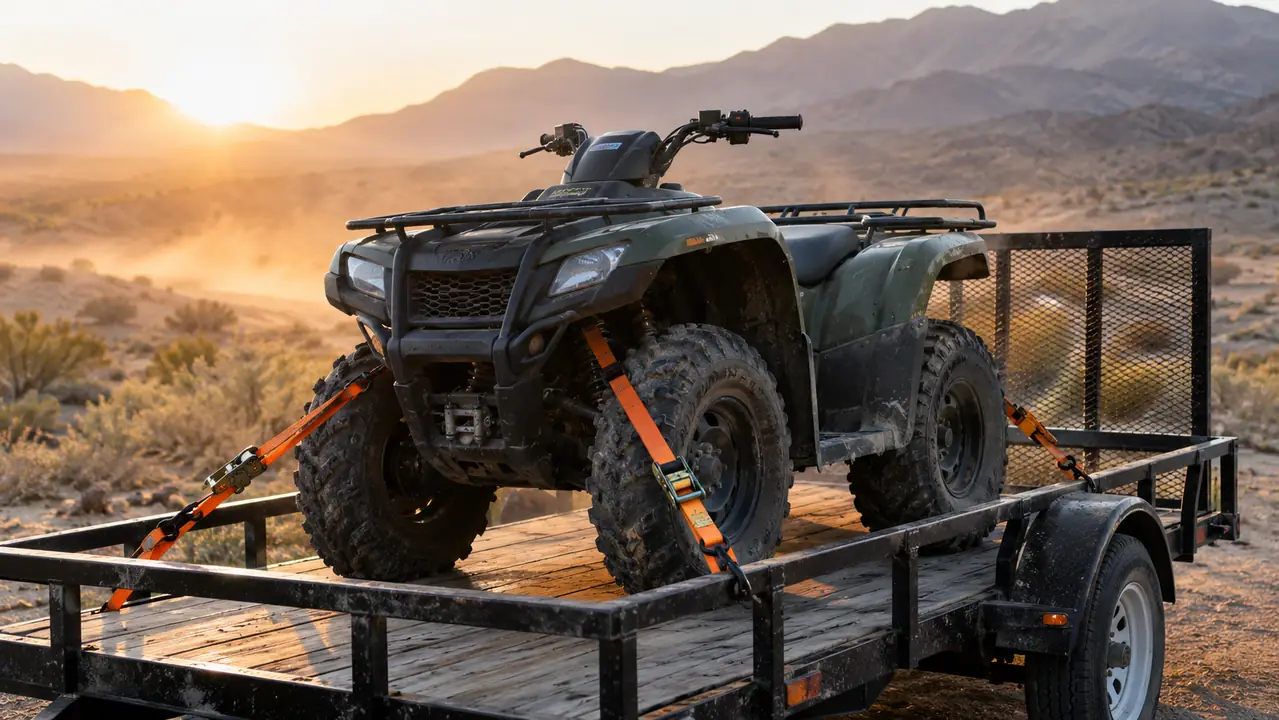
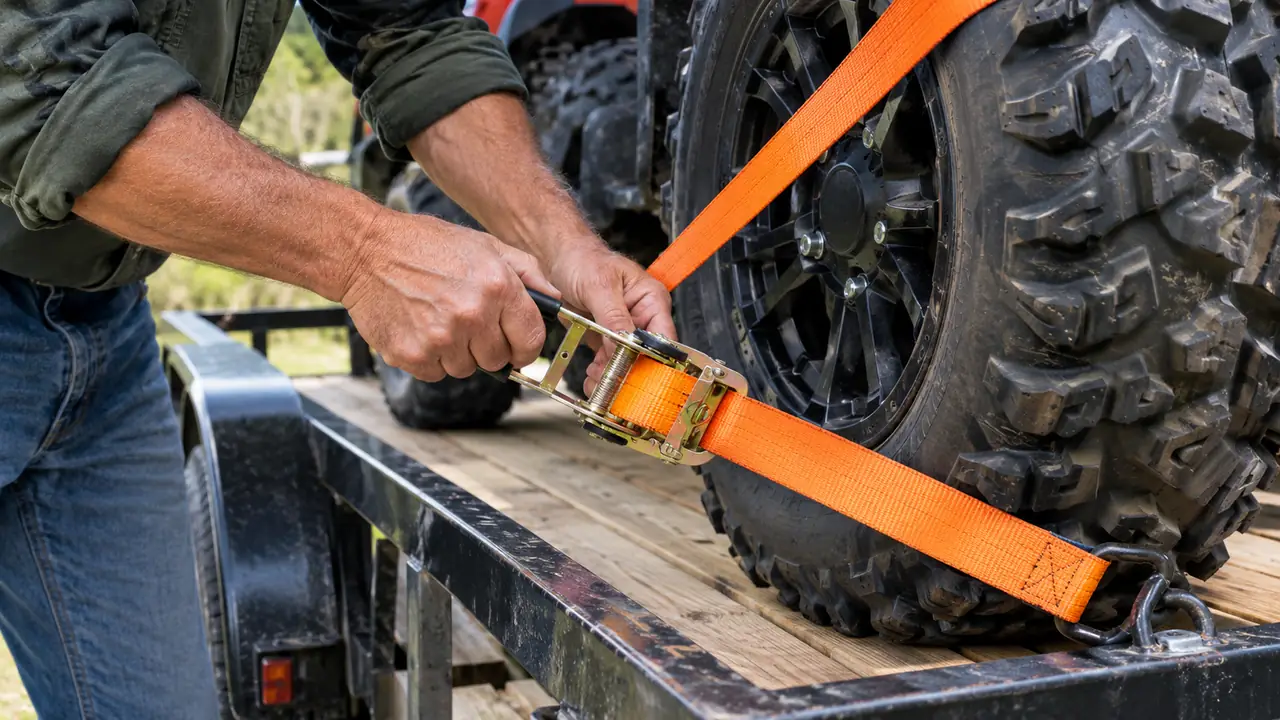
Here is how these straps have been used. My Grizzly rides in a 16 foot open trailer behind my truck. I run one strap across the front wheels and one across the rear, hooked to the frame rails on both sides, then I crank each buckle until the suspension settles about an inch. That is the test I use for every strap I own: if I can bounce the rack by pushing down and the quad moves, it is not tight enough.
I have loaded this way on hot summer mornings in the Mojave and on cold winter evenings after a ride, and that range matters more than it sounds. Webbing and buckles behave differently at both ends of it. FORTEM handles both ends better than the cheap sets I used before, and better than I expected a strap in this class to handle either.
FORTEM rates this set at 1,650 pounds of break strength per strap. Four straps, so call it roughly 6,600 pounds of theoretical holding force on a machine that weighs about 700 pounds dry. That is a large margin, and it is the right kind of margin for a quad that wants to shift around in transit over rough pavement.
The longest single haul was a four hundred mile run to a farm track up north, and the straps did not budge the whole way. I pulled into the yard, pushed on the rack, and the quad sat exactly where I left it. That is the whole point of a strap, and it is easy to forget how rare that is until you have owned ones that do not do it.
The Break Strength Number, Read Honestly
The 1,650 pound figure is a working number, not a fantasy. I have seen cheap straps rated at 1,200 pounds let go at a fraction of that when the webbing had a nick in it. FORTEM webbing is a tight, flat weave with no fuzz along the edges after a year of use. I check it every time I load, because that is what you do with gear that holds a machine, and so far there is nothing to find.
The honest part is this: break strength is not the number that matters most. What matters is the working load, usually about a third of break strength, and the real world test of whether the strap keeps the quad still over a pothole at 55 miles an hour. These straps pass that test. I have hauled this quad hundreds of miles and I have never had to stop and retighten.
I have also pulled against these straps hard enough to test them. When the buckle is tight and the suspension is settled, the webbing has no give. It is not stretchy. That is exactly what you want. A strap that stretches lets the machine rock, and rocking is what wears out hooks and shifts the load on a long drive.
One more thing on the rating: FORTEM prints the working load right on the webbing next to the break strength, which is more than some brands do. A lot of cheap straps only print a single number that is really the break strength, so riders over tighten and then wonder why the strap wears out fast. Having both numbers printed means you know where the safe line is.
Buckle Feel, the Part Nobody Reviews
Here is the thing every review skips: the buckle. A ratchet strap is only as good as how cleanly the pawl seats and how smoothly the ratchet catches. Cheap straps have pawls that skip, which means the strap slowly loosens as you drive, and you only find out when you stop and the machine has shifted six inches.
The FORTEM buckle seats with a solid click when the pawl drops in. It does not skip under load, and the release lever pops the pawl cleanly instead of grinding against it. The handle is long enough to give real leverage, which matters when you are cranking a strap tight enough to settle the suspension.
The honest complaint: this buckle is a two hand job when the webbing is cold. On a winter morning the strap is stiff, and you have to hold the handle with one hand and feed the webbing with the other. It is not a one hand operation. If you are used to a ratchet that flips open, give yourself a minute to get used to it.
There is also a small learning curve to the release. You have to pull the lever and lift the pawl clear, not just yank it. I have watched people fight a similar buckle for ten seconds before it clicks open. Once you learn the motion it is one smooth move, but it is not the slam open release of some cheaper designs.
Webbing and Hardware After a Year
I have had this set for just over a year. I load and unload the quad on most weekends, so call it a hundred or more cycles. The webbing is still flat, the stitching at the looped ends is intact, and the edges have not started to fray where they rub against the trailer rails.
What I did find: the coating on the buckle frame has worn off in a few spots where the webbing passes through. That is cosmetic. It does not affect the function. But it tells me the coating is nothing special, and if you keep your gear showroom clean, know these will show wear.
The hooks are the part I have opinions about. They are the right size for the D rings and frame rails on my trailer, and the rubber coating keeps them from rattling, which is a small thing that saves your sanity on a long haul. That coating has held up better than I expected after a year of hooking and unhooking.
The complaint: the hook opening is a little narrow for the thicker rails on some newer trailers. On mine it is fine. On a heavier trailer I tried, the hook fit but it was snug, and I had to angle it in. If your trailer has fat tube rails, measure the opening before you order.
I have also had these straps in dust, rain, and mud. The high desert will coat everything in a fine powder that works its way into every latch and buckle. I have not had to lubricate the FORTEM ratchet, and the pawl still snaps back the way it did on day one. That tells me the metal and the spring are doing their job.
What a Fabricator Notices
I took one of these buckles apart before I trusted it, because that is what I do with gear that holds a machine. The pawl is a solid piece of metal, not a stamped strip that flexes. The spring that returns it has real tension, and the teeth on the ratchet are cut clean, not rounded. That is the difference between a buckle that skips after ten loads and one that still clicks after a hundred.
The webbing stitch at the looped ends is a double row and it is even. I have seen straps where the stitch wanders off the edge and the whole loop pulls out under load. Not here. The stitching has held through every trip, and I have loaded this quad heavy with camp gear more than once.
The one thing I would change as a fabricator: the hook is riveted, not welded. It is fine for the loads this strap sees, and the rivet has not loosened in a year, but a welded hook would be the difference between a good strap and a great one. For what these cost, the rivet is acceptable.
What I Liked
- Webbing stays flat and free of fray after a hundred or more loads
- Buckle pawl seats cleanly and never skips under load
- Rubber coated hooks stay quiet and hold well on frame rails
- The 1,650 lb break strength claim holds up in real use
Where It Falls Short
- Buckle needs two hands when the webbing is cold
- Hook opening is narrow for fat trailer rails
- Coating on the buckle wears off where the webbing passes through
After a hundred loads, the webbing is still flat and the pawl still seats with a clean click. That is the part the rating on the box never tells you.
What Nobody Tells You Before You Buy
First: a four pack is the right count, but you will use all four. If you haul a quad, you want one strap per axle, crossed. That is four straps minimum, and this set gives you exactly that with none to spare. If you plan to strap a cooler or a spare tire as well, you will want a second set.
Second: the buckles leave marks on your hands. After a long day of loading and unloading, the handle and the pawl leave a red spot on your palm. It is not a cut, just pressure, and it fades. But nobody mentions it, and it surprised me the first time.
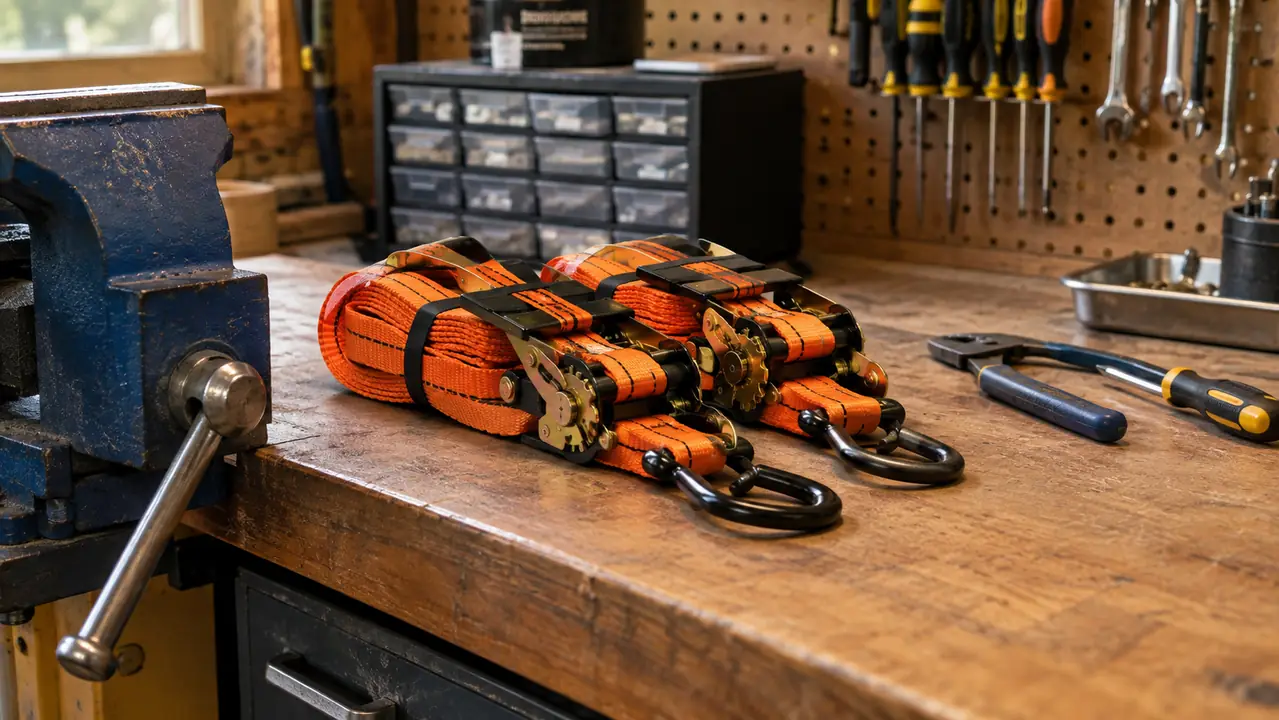
Third: these straps store flat, but they tangle if you throw them in a box loose. I keep each one rolled with the hook tucked through the loop, and they come out ready to use. That is a habit, not a product feature, but it is the difference between a thirty second setup and a five minute fight.
Fourth: the webbing has a slight texture that grips well but picks up sand. If you drop a strap on the ground at a dusty trailhead, it comes up with a coat of grit. Knock it off before you reel it in, or you will be cleaning sand out of the buckle for a while.
Tying It Down Right
The strap is only half the setup. Where you hook it matters more than what the strap is rated for. On my Grizzly I hook to the frame rails, never the plastic racks, and I cross the straps so the quad cannot slide forward or backward. Straight straps let a machine walk, and walking is what stretches and frays webbing.
I also check the load after the first mile. I pull over, push on the rack, and confirm nothing has settled more than expected. Ninety percent of the time it has not moved at all. That is the FORTEM strap doing its job, and it is why I trust this set on the two or three night trips I take each year.
Who This Is For
If you haul a quad, a side by side, or any machine in a trailer, and you are tired of retightening straps on the side of the road, these are for you. They suit the weekend rider who loads once, cranks it tight, and wants it to stay put for a couple hundred miles.
If you are a fabricator or a mechanic, you will like the same things I liked: honest webbing, a solid pawl, and straps that do not fight you. I have owned gear that looked right in the store and failed in the field, and these are not that.
Who Should Skip It
If you only strap a machine down once a month, a cheaper set will do the job and you will not wear it out. If your trailer has very thick tube rails, measure the hook opening before you order. And if you expect one hand operation in every condition, the cold weather two hand buckle will annoy you.
None of that makes the FORTEM set bad. It just makes it not for everyone. For me, the tradeoff is easy: I would rather use two hands on a buckle that seats cleanly than one hand on a buckle that skips.
How These Compare to the Alternatives
I compared these against soft loop tie downs and against two cheaper ratchet sets before settling on the FORTEM four pack. Soft loops are easier on painted racks but they do not cinch as tight, and for hauling a machine in a trailer that matters. The cheaper ratchets had buckles that skipped under load, which is the one thing a strap cannot do.
There is a longer term review on this site that covers the full year of use in more detail, and a separate comparison of ratchet straps against soft loop tie downs if you are still deciding between the two. The short version: for trailer hauling, the ratchet wins.
My pick after a year of hauling
FORTEM is the set I stopped second guessing. If you want the same peace of mind on your next trip, check today's price on Amazon.
Amazon Check Today's Price on Amazon →