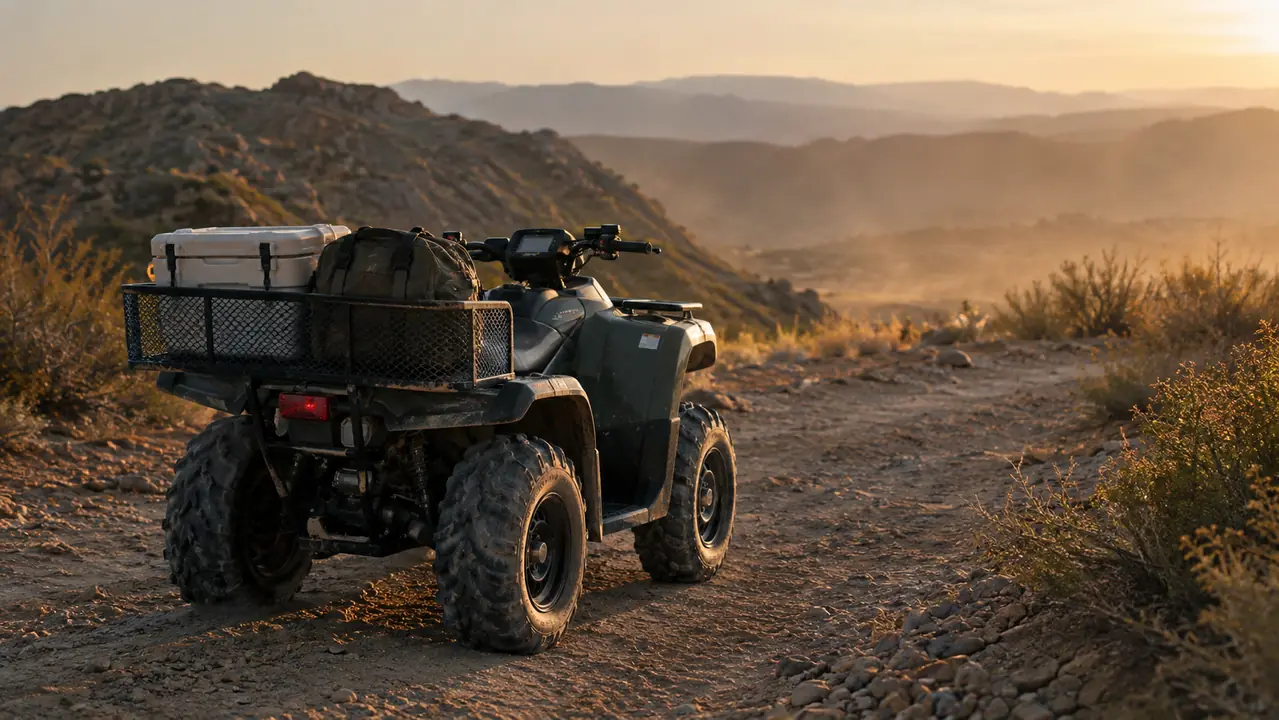
Three weekends a year I pack the Grizzly for an overnight camp trip. For years that meant a soft duffel bungeed to the rear rack, and for years I watched the same thing happen. The bag shifts two inches on the first wash. The bungees stretch. By mile twelve the whole load is leaning sideways against the taillight, and I am stopped on a fire road in the middle of nowhere, repositioning gear and muttering.
So I bought a Titan Ramps rear cargo basket, the steel mesh model rated for 150 pounds. This is the honest review after a full season of desert riding, written from the side of a guy who welds his own brackets and notices when a mount is junk.
The Quick Verdict
A solid steel basket that carries real loads, with mounting clamps you may want to replace. Worth the money if you pack heavy.
Amazon Check Today's Price →A steel basket that actually holds its load
The Titan Ramps rear basket is welded right, carries a real load, and sits solid on the rack. The clamps are the weak point, and they are an easy fix. If you pack for overnight trips, this is the platform to strap it all to.
Amazon Check Today's Price on Amazon →How I've Used It
I ride out of Ridgecrest, California, mostly desert washes and fire roads in the high desert. The quad is a 2019 Yamaha Grizzly 700 4x4, bought used with 1,900 miles on it, and it carries a lot of my camp gear. Two or three nights a year I load it for an overnight trip. The rest of the time it hauls firewood, water jugs, feed bags, and the occasional load of scrap I should have recycled years ago.
The basket has been on the rear rack since last fall. That is about eight months of use, a dozen real trips plus plenty of short hauls. I have loaded it with a 40 pound cooler, a 5 gallon water jug, a duffel, and a folding camp shovel, and I have run that setup down washboard roads that rattle anything loose. I have also run it empty, which is the test that matters for a rack. A basket that rattles when it is empty will drive you mad by mile twenty, and the bolts holding it will work loose before the season ends.
I should be clear about one thing. This is a cargo basket, not a lockable trunk. It does not keep dust out, it does not secure your gear from a thief, and it does not protect a sleeping bag from rain. It is a steel platform with sides. That is all it is. If you understand that going in, you will not be disappointed.
The longest single day I ran with it was a 60 mile loop out toward the dunes, loaded with a cooler, two water jugs, and a bag of tools. We hit washboard for miles and the load never moved. The straps held, the basket stayed square, and when I got home I checked the clamps and found them exactly as I left them. That was the moment I stopped thinking about the basket and just used it.
Mounting: What Nobody Tells You About the Clamps
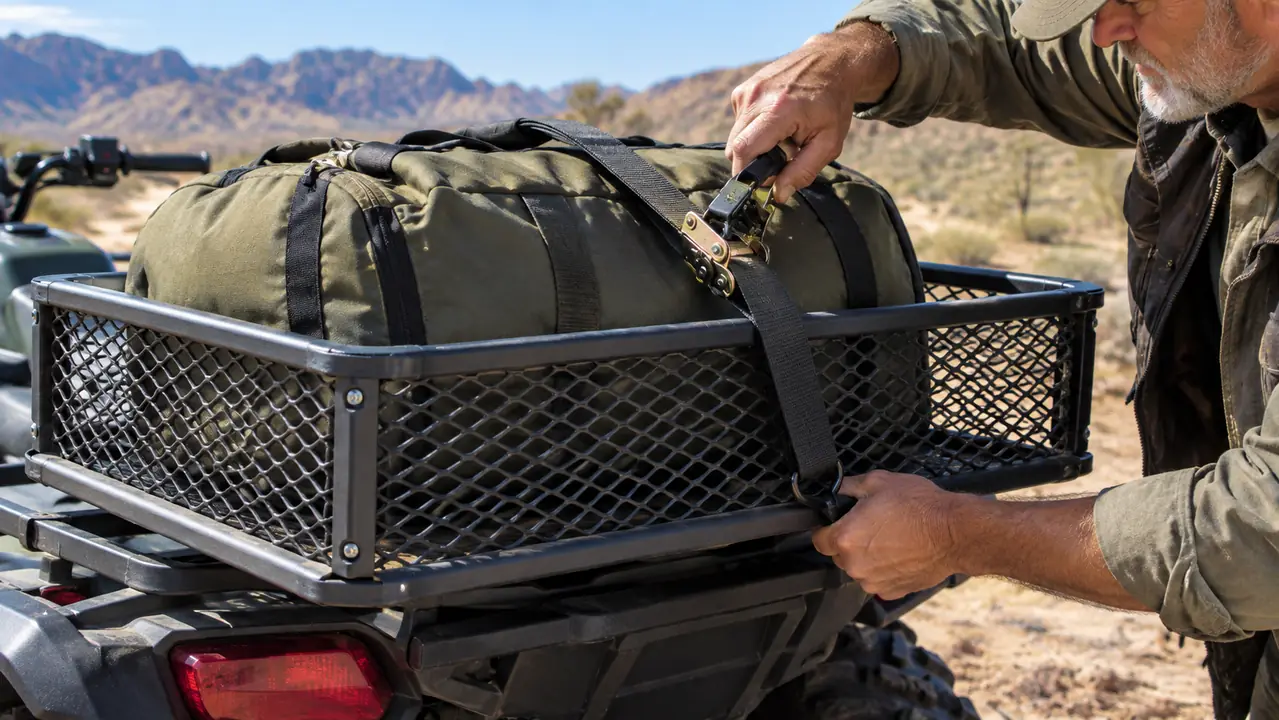
The basket mounts to the factory rear rack with four steel clamps and threaded rods. That is the whole system. You set the basket in place, slide the clamps under the rack tubes, and tighten the nuts from above with a socket.
The honest part is this: the clamps work, but they are the cheapest part of the kit. The steel is thin, the threaded rods are on the small side, and the hardware has the feel of being picked to keep the price down rather than to last forever. On the Grizzly 700 the rack tubes are round, and the clamps grab them fine. I tightened everything down, went for a ride, came back, and retightened. That is normal for any new mount. I retightened again after the second ride. By the third ride it had settled, and I have not touched the clamps since.
What nobody tells you is that the threads will strip if you overtighten. I watched a guy in my riding group get impatient with a similar mount and crank the nuts down with a ratchet instead of a hand wrench. He stripped one rod before he felt it give. The fix is a trip to the hardware store for a slightly longer rod with the same thread, a five minute job and a few dollars. It is not a design flaw. It is a warning to use your hands and stop when the nut is snug.
One more thing about mounting: get the position right the first time. The basket should sit so the load does not cover your taillight or your plate, because covering a taillight on a desert road at dusk is how you get yourself into trouble. I set mine as far forward on the rack as it will go, and I routed the straps clear of the exhaust. You do not want a bungee melting against the muffler.
If you have a welder, the better move is to skip the clamps and weld small tabs onto the rack, then bolt the basket through those. That is what I did after the first month, because I am a fabricator and it took me an afternoon. If you are not set up for that, the clamps are fine. Just check them a couple of times early on and retighten when they settle.
The basket is built better than the price suggests. The mounting clamps are the weakest link, and they are an easy fix.
Weld Quality: What I Found With My Own Eyes
I spent thirty years as a fabricator, so the first thing I did with the basket was flip it over and inspect every joint with a light. That is the part of a review nobody else is going to do for you.
The mesh is welded to the frame at regular intervals, and the frame itself is steel tube with a decent wall thickness. The welds are consistent, no cold spots, no skipped joints, no blobs of filler hiding a gap. That is not what I expected at this price point. I have seen worse welding on racks that cost twice as much, and I have replaced thin stamped baskets that flexed like a cookie sheet.
The basket has a flat bottom and a lip around the top edge. That sounds obvious, but a lot of cheap racks are nothing but mesh and a rim, and gear tips out the sides the first time you hit a bump. This one holds a load square. The steel is thick enough that it does not flex when you cinch a strap down hard, and the mesh openings are small enough that you do not lose small items through the bottom.
I also checked the bottom welds, the ones nobody looks at, because that is where cheap racks fail first. The bottom of this basket has a full mesh floor welded to the frame on all four sides. No gaps, no corner held by a single tack. That matters. A basket that only looks fine from the top will dump your load through a split corner on the first rough section.
Titan Ramps did the welding right on this one. That was the part I was most worried about, because a basket is only as good as its joints, and the joints here are done properly.
Load Capacity: The 150-Pound Claim, Tested
The rating says 150 pounds, and I have run it close to that. The heaviest setup I have put on it was a 40 pound cooler, a full 5 gallon water jug, a duffel with gear, and a folding camp shovel. Call it 90 to 100 pounds total, and it rode fine down a wash at speed.
Here is the part nobody tells you about the weight rating. The basket will hold 150 pounds without breaking a sweat. The question is what your factory rack, your tires, and your handling can do with that much weight on the rear. On the Grizzly 700 the rear rack is rated around 130 to 140 pounds, which means the basket is not the limiting factor. You and your machine are.
Load a hundred pounds of gear on the back and the front end gets light. On a steep climb or in loose sand, that is a real thing to manage. The steering wanders, and if you hit a whoop at speed the rear end wants to step out. I keep my loads under 100 pounds for that reason, not because the basket cannot take more. On pavement or a smooth fire road you would never notice. In a wash, you will.
The good news is that the basket distributes the load well. Because it has a flat bottom and sits low on the rack, the weight stays centered and low, which keeps the handling changes manageable. A tall, wobbly load strapped on top of a soft bag will upset a quad a lot more than the same weight sitting in a solid basket.
For what it is worth, I have also carried a full gas can strapped upright in the basket, and it rode fine. The mesh sides gave the can something to lean against, and a strap around the can kept it from tipping. It is not the intended use, but it shows the basket handles the odd load you did not plan for.
The Dust and Vibration Question
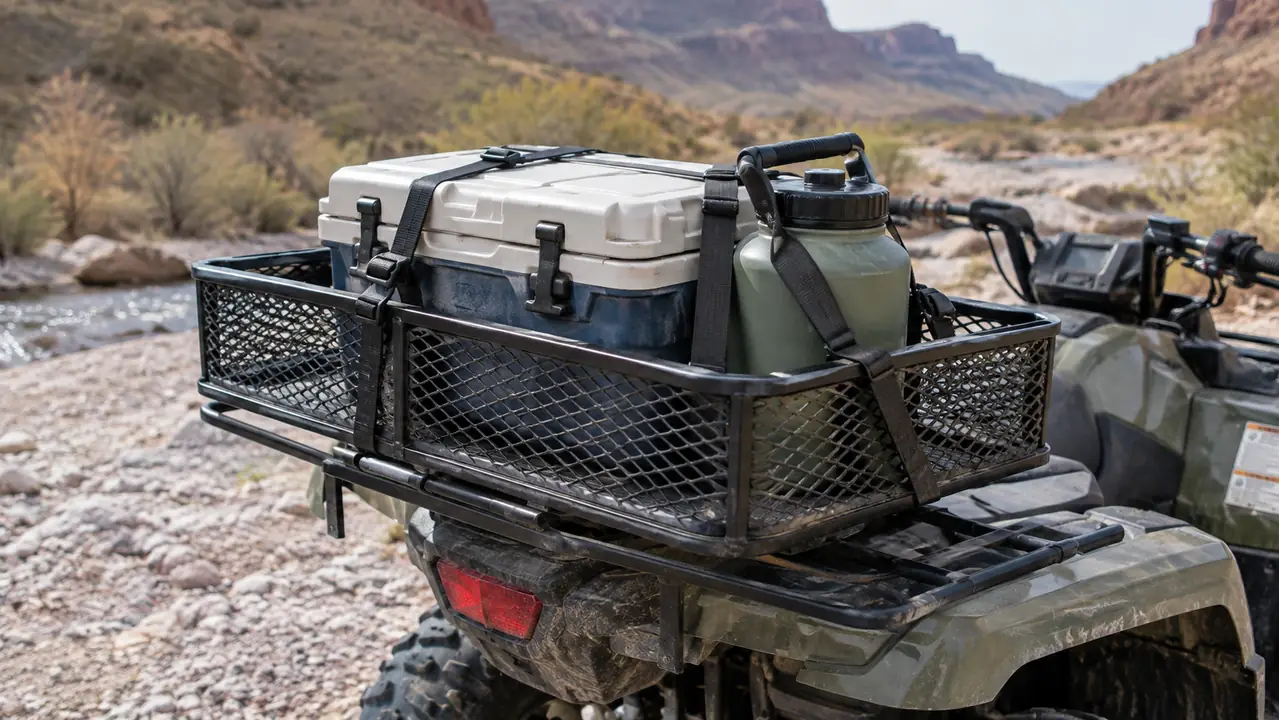
Two things kill gear in the desert: dust and vibration. The basket is open mesh, so dust gets in everywhere, exactly the same as any open rack. If you pack a tent or a sleeping bag in it, wrap them first. I learned that on the first overnight trip, when the inside of my tent bag came out the color of the road.
Vibration is the bigger story. Everything on the rear rack gets shaken, and the basket transmits that shake to whatever is strapped inside it. A hard cooler handles it fine. A plastic toolbox will shed its contents on a long washboard section if you do not secure the lid. I latch the lid and run a bungee across the top of anything that opens, and that solved the problem.
The basket itself does not rattle once the clamps are tight, and that is the test that separates good racks from bad ones. I have owned racks that rattled from day one and drove me up a wall. This one is quiet. The mesh is welded tight, the frame does not flex, and the whole assembly sits solid on the rack. That alone is worth something.
If you ride alone in the desert like I do half the time, you learn to strap gear like you expect a fall. Everything gets a second strap. The basket makes that easy because there are plenty of places to hook a bungee or a ratchet strap, and the top lip gives you something to wrap around. That is a small thing until you need it.
What I Liked
- Welds are clean and consistent for the price
- Flat bottom and top lip hold gear square and centered
- The 150 pound rating is honest; the basket takes it without flex
- Clamps grip round or square rack tubes
- Open mesh drains water and sheds mud
Where It Falls Short
- Mounting clamps and threaded rods are the weak point
- Threads strip if you overtighten
- No padding, so gear needs its own protection from vibration
- Open mesh lets dust in
- You may want to replace the clamps if you ride hard
Who This Is For
This basket is for the rider who packs for a night or two and wants a solid platform to strap gear to. It is for the person who is tired of soft bags sliding sideways and bungees that stretch. If you carry a cooler, water, firewood, or a duffel on the rear rack and you ride gravel, fire roads, or easy trails, this is a good buy. It is also for the rider who checks welds and appreciates that the steel is thicker than the price suggests.
Titan Ramps makes a few of these baskets in different sizes, and this one, the 150 pound steel mesh model, sits in the middle of the range. It is the one I would pick for a Grizzly or any mid-size utility quad, and it is the one I would pick again if mine wore out.
Who Should Skip It
If you only ride pavement and never carry more than a small bag, you do not need this. The basket adds weight and a little wind drag, and a simple bungee setup would do the job for less money and less fuss.
If you are loading 150 pounds of gear on every ride, think about the rack rating on your quad before you buy, not after. The basket is not the weak link. Your factory rack and your handling are.
And if you hate checking bolts, the clamps will annoy you. They settle in after a few rides, but those first few rides need a retighten. That is a ten minute job, done twice, and then it is done. If that sounds like too much, a rack with more substantial mounting hardware might suit you better, though it will cost more.
The honest verdict after a full season
Titan Ramps built a solid steel basket here, and the only real flaw is the mounting clamps, which you can replace or work around. For a rider who packs for a night or two, it earns its place on the rack.
Amazon Check Today's Price on Amazon →