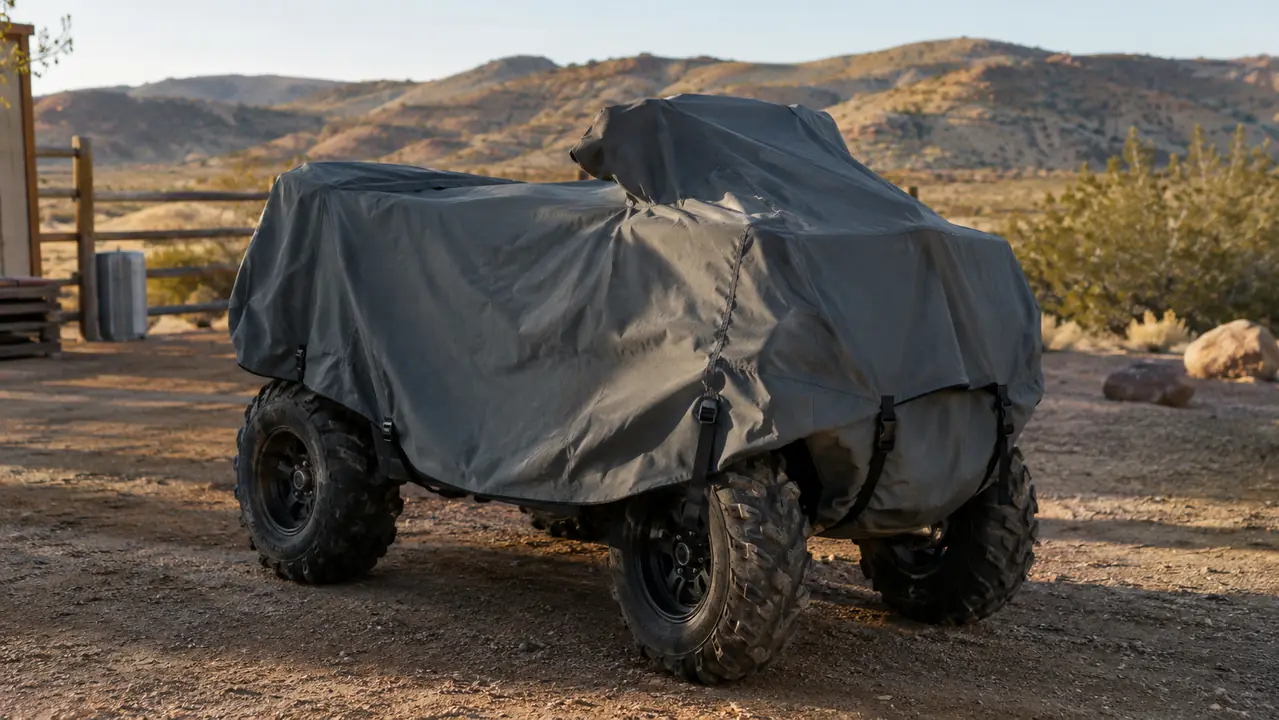
The short answer: for outdoor storage, a fitted cover beats a tarp, and it is not close. I ran tarps over quads for twenty years, because tarps were what I had on hand, and I learned every way a tarp can let you down. Last year I finally bought a fitted 420D cover from the ATV Cover brand, put it on my 2019 Grizzly, and left it on through wind, dust, rain and three months of high-desert sun. I wish I had made the switch years earlier. A tarp is cheaper, and I will tell you exactly where it is the smarter buy, but if your machine sits outside in the weather, the fitted cover is the better tool for the job.
Let me be clear about what we are comparing, because the words get muddy. A tarp is a flat sheet of polyethylene or poly canvas that you drape over the machine and hold down with rope, bungees or rocks. A fitted cover is shaped like the quad, sewn with straps and buckles, and made from a heavier woven material like 420D ripstop. They do the same headline job, keep the weather off the machine, but they go about it completely differently. That difference is what this article is about.
Before the rows, a little context. My garage is a shop first. Two bays, MIG welder, drill press, bench vise, parts bins. There is no room for a 700-pound quad in there, so mine lives outside in the side yard. That means the only thing between my Grizzly and the weather is whatever I put on it. I have used blue tarps, a heavy poly tarp, and now the fitted cover on the same machine, in the same spot, through the same seasons. That is the test I am reporting.
How I Tested
I did not run this as a controlled experiment, because nobody actually does that. I used a tarp for years and kept notes on what failed, then switched to the fitted cover and kept the same kind of notes. The Grizzly sits in the open, facing west, so it takes the worst of the afternoon sun, dust blowing off the wash, and the occasional hard rain. With the tarp I rigged rope and bungees, and I re-rigged them more often than I want to admit. With the fitted cover I pulled the straps tight and walked away.
The things I watched for were the things that actually kill gear in my country: water pooling, condensation underneath, UV cracking on plastics, dust working its way into the controls, and wind chafe on fenders and mirrors. Every couple of weeks I pulled the cover or the tarp off and checked the seat, the grips, the fenders, the fasteners and the tires. I also checked the cover itself for wear, because a cover that falls apart in one season is no better than a tarp. All of that went into the rows below.
One honest note up front. I live in the high desert, not the Gulf Coast. We get dry summers, cold windy winters, and rain maybe a dozen times a year. If you store a quad in a wet, humid climate, moisture behaves differently and you should weight that heavily. I will come back to it, because it is the one place the answer can flip.
The Comparison at a Glance
Here is how the two stack up after a year side by side. I marked a winner on every row, and I let the tarp take the rows it genuinely wins. If every row came out in favor of the cover, the table would be lying, and you would catch it the first windy night.
| ATV Cover | Flat Tarp | |
|---|---|---|
| Price | Costs more, but built for years of service | A fraction of the price, easy to replace |
| Fit | Fitted shape, cinches tight around the body and tires | Flat sheet, you rig the shape yourself with rope |
| Wind behavior | Straps and buckles hold it down, no flapping | Flaps in a breeze, chafes fenders and mirrors |
| Water | Sheds rain, drains off the high spots | Can pool and sag if not pitched tight |
| Moisture underneath | Sits off the surfaces, lets some air move | Laid flat, traps more condensation in humid air |
| UV and sun | 420D ripstop made to sit in the sun | Cheap tarps break down after a season or two of sun |
| Versatility | Made for one job, fits an ATV | Covers firewood, gear, a workbench, whatever |
| Storage when off | Folds up, takes a shelf or a hook | Packs smaller, easier to stash in a toolbox |
| Best for | Quads parked outside, exposed to sun and wind | Covered storage where you just want dust off |
Where the ATV Cover Wins
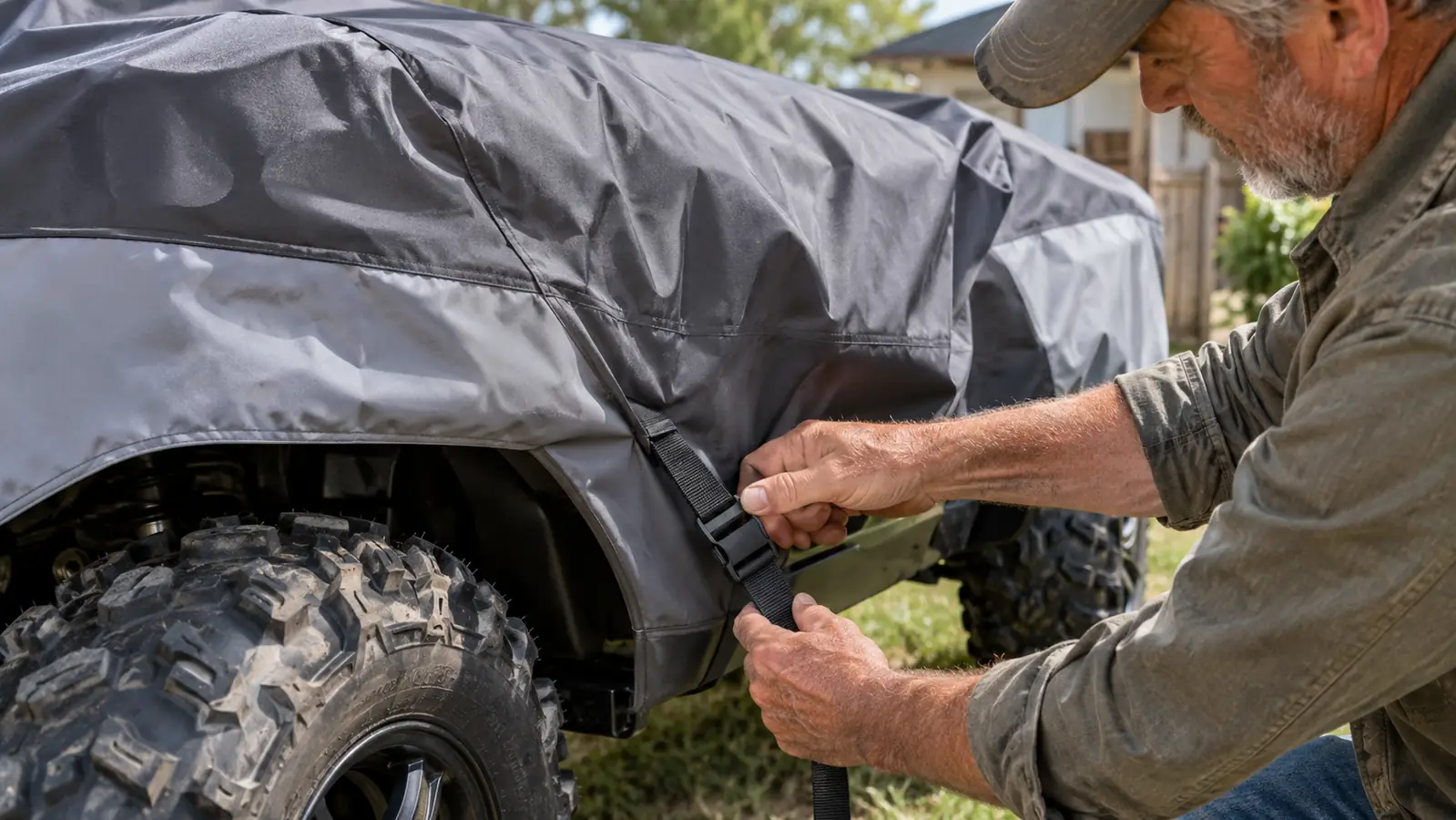
The fitted shape is the whole game. A tarp is a flat sheet, and a Grizzly is not flat. You spend twenty minutes rigging rope and bungees, and the wind still finds a corner, gets under it, and snaps it against the plastics all night. The fitted cover drops over the machine, you pull three straps, and you are done in two minutes. No knots, no rocks holding down corners, no re-rigging after every windstorm. I have watched this cover sit through 40-mile-an-hour desert wind without moving an inch. That alone was worth the switch.
Then there is the sun, which is the quiet killer out here. My side yard bakes in the afternoon, and UV is what cracks a quad's plastics and turns grips brittle. A cheap tarp lasts a season or two of that before it goes stiff, then starts tearing at the corners where the wind works it. The ATV Cover's 420D ripstop shell has now been through a full year of that same sun and it still pulls tight, still sheds water, and still looks like it has another year in it. I have paid less than this for tarps that were gone in a season. Over two years, the cover ends up the cheaper answer.
It also keeps dust out of the places that matter. Under a tarp, dust still sifted in around the edges and settled on the seat and in the throttle and brake areas. The fitted cover cinches down around the body and tires, so far less dust gets in. Less grit in the moving parts means less wear and less time with a rag and a can of cleaner. It is not a sealed bag, nothing is, but the difference was obvious the first time I lifted the cover off.
Where a Tarp Wins
I am not going to pretend the tarp has no place, because it does. Price is the big one. If money is genuinely tight, a tarp is a real option, not a toy, and I used one for years without my machine falling apart. You are trading your time for the savings. Every windy night is a risk of chafe, and you will re-tighten it more often than you want to. But for a rider who stores the quad under a carport or in a dry shed and only needs something to keep dust off, a tarp may be all you ever need.
The other thing a tarp has going for it is that it is not married to the machine. One tarp covers the quad one week, the woodpile the next, or the trailer, or the workbench. A fitted cover only does one job. Tarps are also easier to replace when they wear out, and cheaper to keep a spare of. And if you are in a humid climate, a tarp draped loose can actually breathe better than a tight waterproof cover, because you control the airflow with how you hang it. That is the one place I would honestly steer a rider toward the tarp: wet, humid storage where condensation is the enemy.
Twenty minutes of rigging rope and bungees, and the wind still got under a corner and snapped it against the plastics all night. The fitted cover dropped over the machine and I was done in two minutes.
A year of desert sun, wind and rain, and it still pulls tight.
The fitted 420D cover has held up where every tarp I owned gave up. If your quad sits outside, this is the one to start with.
Amazon Check Today's Price on Amazon →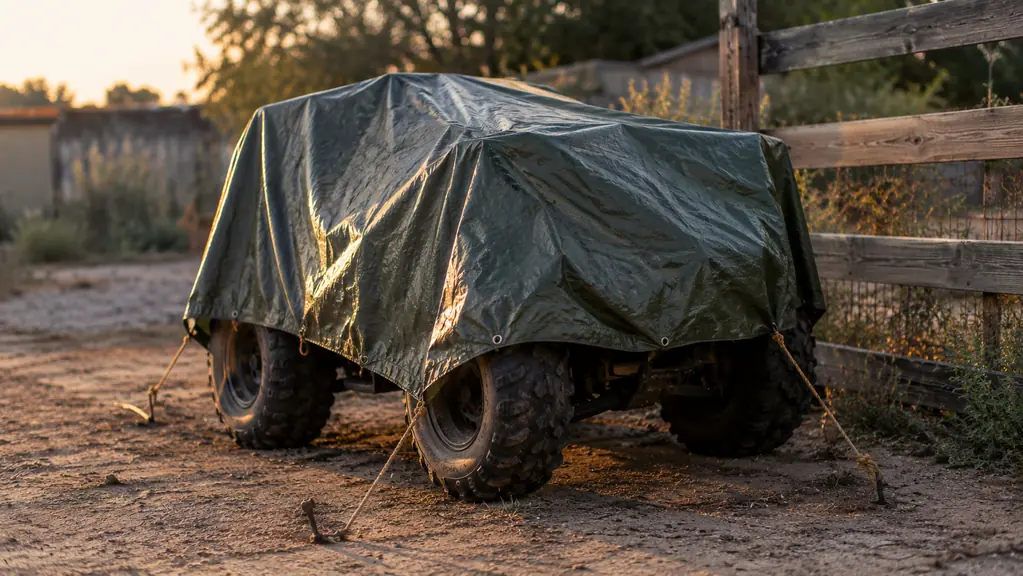
Who Should Buy Which
Buy the fitted cover if your quad lives outside, exposed, like mine. That is the case it was built for, and it is exactly where a tarp falls apart fastest. If you ride often, you will appreciate the two-minute on, two-minute off. I have gotten lazy about covering the quad between rides before, because the tarp was a chore. With the cover, there is no excuse, so the machine stays protected all week, not just when I have the energy for rope work.
Buy a tarp if your machine sleeps indoors or under a roof and you mostly want to keep dust off it, or if you want one sheet that covers a lot of different things. And in a humid climate, test the condensation question before you commit to any waterproof cover, tarp or fitted. Me, I keep a tarp folded in the shop for wood and gear, and the ATV Cover stays on the Grizzly. That turned out to be the best of both, and it is the arrangement I would recommend to most riders.
Condensation: The Real Question
This is the thing that trips people up, and I want to spend real time on it because it can flip the whole decision. A waterproof cover, tarp or fitted, keeps rain out. That is the good part. But if the cover is sealed tight and the air underneath is warmer and more humid than the air outside, water condenses on the inside of the shell and on the machine. I have seen friends pull a cover off a quad in the spring and find the seat damp and the metal showing the first rust. That is the worst outcome in this whole discussion.
In the high desert this is rarely a problem, because the air is dry and it cools off fast at night. The fitted cover sits off the surfaces in most places, and the little bit of airflow it allows has kept mine dry through every rain. But if you are coastal, or in the Southeast, or anywhere that stays humid for months, treat this as the deciding factor. Drape a tarp loosely so air moves, or look for a cover that breathes, or store the quad under a roof. A dry quad under a cheap tarp beats a rusted quad under an expensive cover, and I will say that plainly.
The Tradeoffs Nobody Mentions
Two things about fitted covers that are easy to miss. First, they are not indestructible. The buckles and straps are the weak points, and a loose strap left to flap in the wind will wear. I check mine when I check the oil, and I tuck loose strap ends under the cover so they cannot chafe. Second, a cover holds heat. On a hot summer afternoon the shell is warm to the touch, and if you ride right after uncovering, the seat and plastics will be warm. It has never hurt anything on mine, but it is real.
The other thing is fit. The ATV Cover is sold as a universal size that fits most quads, and it has handled the Grizzly's racks and wide stance fine. But if you have a machine with an unusually tall windshield or a big rear box, measure it before you buy. A cover that is too small is a cover that will blow off, and that is worse than a tarp, because you trusted it to protect the machine. When in doubt, go up a size.
The Bottom Line
If your quad sits outside like mine, buy the fitted cover and do not look back. It costs more up front, and it wins the rows that actually matter: fit, wind, water and sun. Keep a tarp around if you want, I do, but put the ATV Cover on the machine. Fourteen months in, my Grizzly's plastics still look new, nothing has rusted, and I have not re-rigged a rope once. For me, that settles it. For a rider in a humid climate, the tarp can win, and I have told you exactly why. The rest is matching the tool to your yard.
Stop re-rigging rope and bungees every windy night.
The fitted 420D cover drops over the quad, cinches in two minutes, and has outlasted every tarp I ever owned. If your machine lives outside, this is the move.
Amazon Check Today's Price on Amazon →